
Titanium metal is obtained from the mineral rutile, TiO2. The process requires multiple steps, as shown in the following reactions: TiO2(s) + 2 Cl2(g) + 2 C(s) → TiCl4(s) + 2 CO(g) TiCl4(s) + 2 Mg(s) → Ti(s) + 2 MgCl2(s) b. How many moles of TiO2 are needed to form one mole of titanium?
Verified step by step guidance
1
Step 1: Analyze the problem and identify the goal. The goal is to determine how many moles of TiO2 are required to produce 1 mole of titanium (Ti). This involves understanding the stoichiometry of the reactions provided.
Step 2: Examine the first reaction: TiO2(s) + 2 Cl2(g) + 2 C(s) → TiCl4(s) + 2 CO(g). From this reaction, 1 mole of TiO2 reacts to produce 1 mole of TiCl4. This establishes a 1:1 molar ratio between TiO2 and TiCl4.
Step 3: Examine the second reaction: TiCl4(s) + 2 Mg(s) → Ti(s) + 2 MgCl2(s). From this reaction, 1 mole of TiCl4 reacts to produce 1 mole of Ti. This establishes a 1:1 molar ratio between TiCl4 and Ti.
Step 4: Combine the stoichiometric relationships from both reactions. Since 1 mole of TiO2 produces 1 mole of TiCl4 (from the first reaction), and 1 mole of TiCl4 produces 1 mole of Ti (from the second reaction), the overall stoichiometry shows that 1 mole of TiO2 is required to produce 1 mole of Ti.
Step 5: Conclude that the number of moles of TiO2 needed to form 1 mole of titanium is 1 mole, based on the stoichiometric relationships in the given reactions.
Verified video answer for a similar problem:
This video solution was recommended by our tutors as helpful for the problem above
Video duration:
1m
Play a video:
Was this helpful?
Key Concepts
Here are the essential concepts you must grasp in order to answer the question correctly.
Stoichiometry
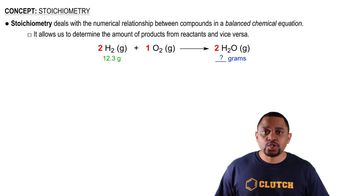
Stoichiometry is the branch of chemistry that deals with the quantitative relationships between the reactants and products in a chemical reaction. It allows us to calculate the amounts of substances involved based on balanced chemical equations. Understanding stoichiometry is essential for determining how many moles of a reactant are needed to produce a desired amount of product.
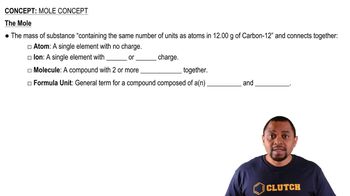
The mole concept is a fundamental principle in chemistry that defines the amount of substance. One mole is equivalent to 6.022 x 10^23 entities (atoms, molecules, etc.). This concept is crucial for converting between grams and moles, enabling chemists to quantify reactants and products in chemical reactions accurately.
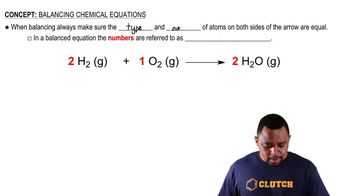
Chemical reactions involve the transformation of reactants into products, and balancing these reactions ensures that the law of conservation of mass is upheld. Each side of a balanced equation must have the same number of atoms for each element. In the given reactions, balancing is necessary to determine the exact mole ratios between TiO2 and titanium, which is vital for solving the problem.