Join thousands of students who trust us to help them ace their exams!
Multiple Choice
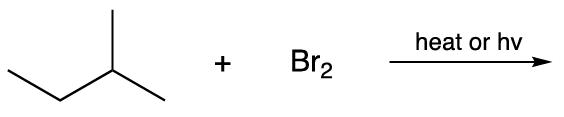
Determine the major product(s) of the following alkane reaction. (Assume monosubstitution.)
A
B
C
D
0 Comments
Verified step by step guidance
1
Identify the type of reaction: This is a free radical halogenation reaction of an alkane with bromine (Br\_2) under heat or light (hv), which typically results in monosubstitution of a hydrogen atom by a bromine atom.
Determine the different types of hydrogen atoms in the alkane: Look at the alkane structure and classify the hydrogens as primary (1°), secondary (2°), or tertiary (3°) based on the carbon to which they are attached. In this molecule, identify the number of each type of hydrogen.
Apply the selectivity of bromine substitution: Bromine is more selective than chlorine and prefers to substitute at the most stable radical position, which is usually the tertiary carbon first, then secondary, and lastly primary. This is due to the relative stability of the radicals formed during the reaction.
Calculate the relative reactivity of each type of hydrogen: Use the relative reactivity values for bromine (typically tertiary:secondary:primary = 1600:80:1) to determine which hydrogens are most likely to be substituted. Multiply these values by the number of each type of hydrogen present to find the major product(s).
Draw the major monosubstituted product(s): Replace the hydrogen(s) at the most reactive carbon(s) with bromine to show the major product(s) of the reaction, ensuring only one substitution occurs as specified.




 Verified step by step guidance

