Join thousands of students who trust us to help them ace their exams!
Multiple Choice
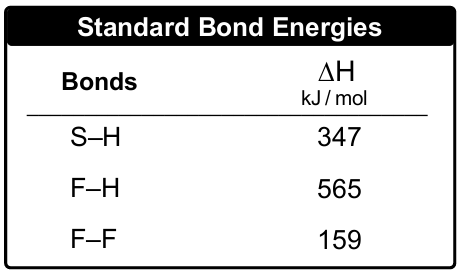
Consider the following equation: Determine the bond enthalpy value for the F–S bond.
A
-2301.0 kJ/mol
B
335.5 kJ/mol
C
-1171.5 kJ/mol
D
1301.0 kJ/mol
4 Comments
Verified step by step guidance
1
Write the balanced chemical equation and note the given enthalpy change: \(\mathrm{H_2S (g) + 3 F_2 (g) \rightarrow SF_4 (g) + 2 HF (g)}\) with \(\Delta H = -1301 \ \mathrm{kJ/mol}\).
Identify all bonds broken and formed in the reaction. Bonds broken (reactants): 2 S–H bonds and 3 F–F bonds. Bonds formed (products): 4 F–S bonds and 2 F–H bonds.
Calculate the total bond energy of bonds broken using the given bond energies: \(2 \times 347 \ \mathrm{kJ/mol}\) for S–H and \(3 \times 159 \ \mathrm{kJ/mol}\) for F–F.
Calculate the total bond energy of bonds formed, except for the unknown F–S bond energy: \(2 \times 565 \ \mathrm{kJ/mol}\) for F–H bonds plus \(4 \times\) (unknown F–S bond energy).
Use the bond enthalpy relation: \(\Delta H = \text{Bonds broken} - \text{Bonds formed}\). Rearrange to solve for the unknown F–S bond energy: \(\text{F–S bond energy} = \frac{\text{Bonds broken} - \Delta H - \text{Energy of F–H bonds}}{4}\).



 Verified step by step guidance

