Join thousands of students who trust us to help them ace their exams!
Multiple Choice
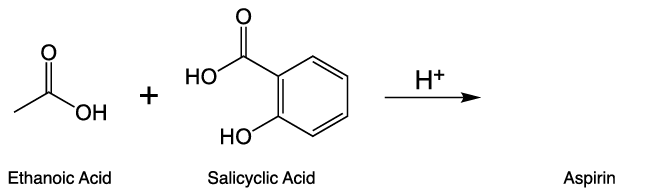
Aspirin also known as acetylsalicyclic acid possesses an ester group that is formed from the reaction between ethanoic acid and salicyclic acid. Determine the structure of aspirin after the condensation between ethanoic acid and salicyclic acid.
A
B
C
D
0 Comments
Verified step by step guidance
1
Identify the two reactants involved in the esterification reaction: salicylic acid and ethanoic acid. Salicylic acid contains both a hydroxyl (-OH) group and a carboxylic acid (-COOH) group, while ethanoic acid is a simple carboxylic acid (CH3COOH).
Focus on the functional groups that participate in the esterification: the hydroxyl group (-OH) of salicylic acid and the carboxyl group (-COOH) of ethanoic acid. During the reaction, the hydroxyl group of salicylic acid reacts with the carboxyl group of ethanoic acid.
Understand the condensation reaction mechanism: the hydroxyl group (-OH) from salicylic acid and the hydrogen (H) from the carboxyl group of ethanoic acid combine to form water (H2O), which is removed during the reaction.
Form the ester bond by connecting the oxygen atom from the hydroxyl group of salicylic acid to the carbonyl carbon of ethanoic acid, resulting in the ester functional group (-COO-) in the product.
Draw the final structure of aspirin by replacing the hydroxyl group (-OH) on the benzene ring of salicylic acid with the ester group formed from ethanoic acid, ensuring the rest of the salicylic acid structure remains intact.




 Verified step by step guidance

