Join thousands of students who trust us to help them ace their exams!
Multiple Choice
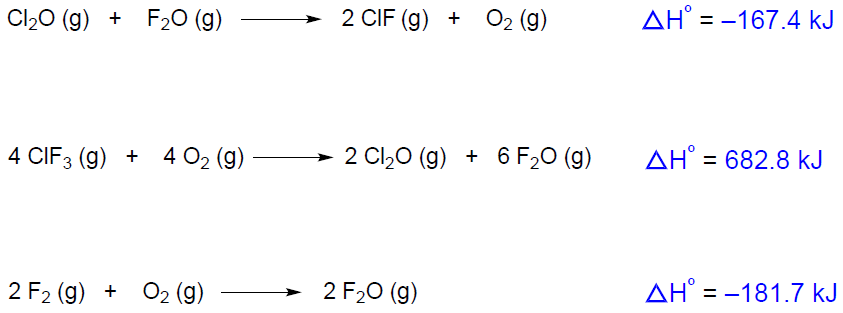
Calculate the ∆Hrxn for Given the following reactions:
A
-177.85 kJ
B
-355.73 kJ
C
-258.36 kJ
D
-487.27 kJ
0 Comments
Verified step by step guidance
1
Identify the target reaction: \(\mathrm{ClF (g) + F_2 (g) \rightarrow ClF_3 (g)}\) and the given reactions with their enthalpy changes (\(\Delta H^\circ\)).
Use Hess's Law to combine the given reactions to obtain the target reaction. This involves:
- Manipulating the given reactions (reversing, multiplying by coefficients) so that when added, the unwanted species cancel out and the target reaction remains.
- Remember to adjust the \(\Delta H^\circ\) values accordingly (reverse sign if reaction is reversed, multiply by the same factor if reaction is multiplied).
After adjusting and adding the reactions, sum the corresponding \(\Delta H^\circ\) values to find \(\Delta H_{rxn}\) for the target reaction.
Verify that all species except those in the target reaction cancel out properly, ensuring the correctness of the combined reaction and the calculated \(\Delta H_{rxn}\).



 Verified step by step guidance

