Join thousands of students who trust us to help them ace their exams!
Multiple Choice
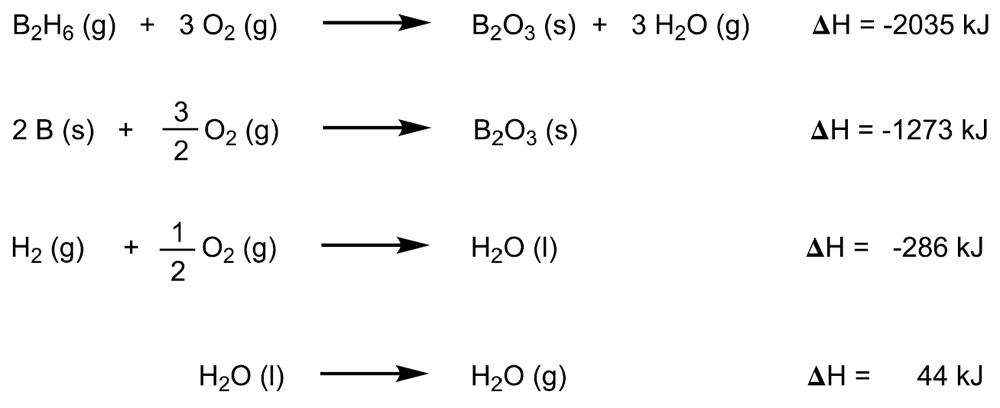
The formation of diborane from its elemental components is given below: Determine the enthalpy value for the formation of diborane when given the enthalpy values for the following partial reactions:
A
+36 kJ
B
–3550 kJ
C
+520 kJ
D
+27 kJ
E
–171 kJ
0 Comments
Verified step by step guidance
1
Identify the target reaction for which we want to find the enthalpy change: \(2 \text{B} (s) + 3 \text{H}_2 (g) \rightarrow \text{B}_2\text{H}_6 (g)\).
Use the given reactions and their enthalpy changes to construct a Hess's Law cycle that relates the target reaction to the known reactions. The goal is to combine the given reactions so that their sum equals the target reaction.
Write the enthalpy change for the combustion of diborane: \(\text{B}_2\text{H}_6 (g) + 3 \text{O}_2 (g) \rightarrow \text{B}_2\text{O}_3 (s) + 3 \text{H}_2\text{O} (g)\) with \(\Delta H = -2035 \text{ kJ}\).
Write the enthalpy changes for the formation of \(\text{B}_2\text{O}_3\) and \(\text{H}_2\text{O}\) from their elements: \(2 \text{B} (s) + \frac{3}{2} \text{O}_2 (g) \rightarrow \text{B}_2\text{O}_3 (s)\) with \(\Delta H = -1273 \text{ kJ}\), \(\text{H}_2 (g) + \frac{1}{2} \text{O}_2 (g) \rightarrow \text{H}_2\text{O} (l)\) with \(\Delta H = -286 \text{ kJ}\), and \(\text{H}_2\text{O} (l) \rightarrow \text{H}_2\text{O} (g)\) with \(\Delta H = 44 \text{ kJ}\).
Combine the enthalpy changes using Hess's Law: Start with the combustion of diborane, subtract the formation of \(\text{B}_2\text{O}_3\) from boron and oxygen, subtract the formation of liquid water from hydrogen and oxygen, and add the vaporization of water to gas. The sum of these enthalpy changes will give the enthalpy of formation of diborane.



 Verified step by step guidance

