Join thousands of students who trust us to help them ace their exams!
Multiple Choice
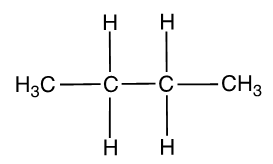
Draw a constitutional isomer of butane.
A
B
C
D
1 Comment
Verified step by step guidance
1
Step 1: Understand the concept of constitutional isomers. Constitutional isomers are compounds that have the same molecular formula but different connectivity of atoms. For butane (C4H10), this means the atoms are connected in different ways to form distinct structures.
Step 2: Identify the given structure. The first image shows the straight-chain form of butane, where four carbon atoms are connected in a continuous chain: CH3-CH2-CH2-CH3.
Step 3: To draw a constitutional isomer, rearrange the carbon atoms to create a different connectivity. For butane, the main alternative is a branched structure called isobutane (or methylpropane), where three carbons form a chain and the fourth carbon is attached as a branch to the middle carbon.
Step 4: Draw the branched isomer by placing a central carbon atom bonded to three other carbons: one carbon on the left, one on the right, and one as a branch on top. Each carbon should have enough hydrogen atoms to satisfy the four bonds per carbon rule.
Step 5: Verify that the molecular formula remains C4H10 and that the connectivity differs from the straight-chain butane. This confirms you have successfully drawn a constitutional isomer of butane.




 Verified step by step guidance

