Join thousands of students who trust us to help them ace their exams!
Multiple Choice
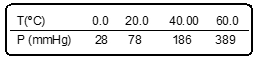
Vapor pressure measurements at various temperature values are given below. Determine the molar heat of vaporization for cyclohexane.
A
11,520 J/mol
B
72,193 J/mol
C
33,147 J/mol
D
52,968 J/mol
1 Comment
Verified step by step guidance
1
Convert the given temperatures from Celsius to Kelvin by adding 273.15 to each temperature value. This is necessary because the Clausius-Clapeyron equation requires absolute temperature.
Calculate the natural logarithm of the vapor pressure values (P) given in mmHg for each temperature.
Use the Clausius-Clapeyron equation in its linear form: \(\ln P = -\frac{\Delta H_{vap}}{R} \cdot \frac{1}{T} + C\), where \(\Delta H_{vap}\) is the molar heat of vaporization, \(R\) is the gas constant (8.314 J/mol·K), \(T\) is the temperature in Kelvin, and \(C\) is a constant.
Plot \(\ln P\) versus \(\frac{1}{T}\) and determine the slope of the resulting straight line. The slope will be equal to \(-\frac{\Delta H_{vap}}{R}\).
Calculate the molar heat of vaporization \(\Delta H_{vap}\) by multiplying the slope by \(-R\): \(\Delta H_{vap} = -\text{slope} \times R\).


 Verified step by step guidance

