Join thousands of students who trust us to help them ace their exams!
Multiple Choice
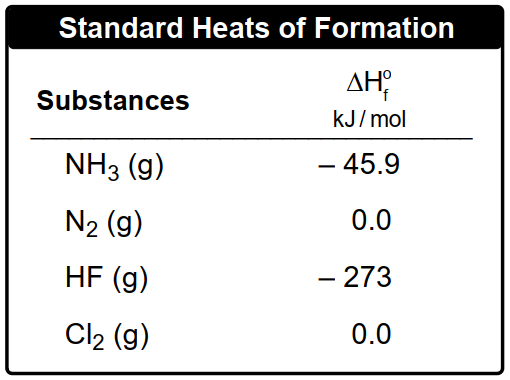
Consider the following equation: 2 ClF3(g) + 2 NH3(g) → 1 N2(g) + 6 HF (g) + 6 Cl2(g) ΔHrxn = –1196 kJ Determine the standard enthalpy of formation for chlorine trifluoride, ClF3.
A
-175.1 kJ
B
350.2 kJ
C
442.0 kJ
D
-1638 kJ
3 Comments
Verified step by step guidance
1
Write the given reaction and the enthalpy change: 2 ClF\_3(g) + 2 NH\_3(g) → 1 N\_2(g) + 6 HF(g) + 6 Cl\_2(g), ΔH\_rxn = -1196 kJ.
Recall the enthalpy change of the reaction can be expressed using standard enthalpies of formation as: ΔH\_rxn = Σ n ΔH\_f(products) - Σ n ΔH\_f(reactants), where n is the stoichiometric coefficient.
Substitute the known ΔH\_f values from the table: ΔH\_f(NH\_3) = -45.9 kJ/mol, ΔH\_f(N\_2) = 0.0 kJ/mol, ΔH\_f(HF) = -273 kJ/mol, ΔH\_f(Cl\_2) = 0.0 kJ/mol, and let ΔH\_f(ClF\_3) = x (unknown).
Set up the equation: -1196 = [1(0.0) + 6(-273) + 6(0.0)] - [2(x) + 2(-45.9)]. Simplify the right side to isolate x.
Solve the resulting equation for x, which represents the standard enthalpy of formation of ClF\_3.


 Verified step by step guidance

