Saponification is an ester reaction in which aqueous hydroxide reacts with an ester and cleaves the ester bond. This breaks the linkage between the carbonyl portion and the oxygen attached to the alkyl group, giving two products: a carboxylate anion and an alcohol. In Ester Reactions: Saponification, the hydroxide source is $OH^-$
The carboxylate anion is the conjugate base form of a carboxylic acid, meaning it corresponds to a carboxylic acid after loss of $H^+$
Overall, the reaction can be summarized as \(\text{ester} + OH^- \rightarrow \text{carboxylate anion} + \text{alcohol}\)
0
Concept
Ester Reactions: Saponification
Video duration:
1m
Play a video:
Ester Reactions: Saponification Video Summary
Saponification is a specific type of ester reaction where a hydroxide ion (OH-) in aqueous solution reacts with an ester. This process cleaves the ester bond, resulting in the formation of a carboxylate anion and an alcohol. The carboxylate anion is essentially the conjugate base of a carboxylic acid, which means it is formed when a hydrogen ion (H+) is removed from the acid.
In the saponification reaction, the ester linkage is broken by the hydroxide ion. As the bond is cleaved, the oxygen atom from the ester gains a hydrogen atom, leading to the formation of an alcohol. Simultaneously, the carbonyl carbon of the ester gains an oxygen atom, resulting in the negatively charged carboxylate anion. This transformation highlights the relationship between saponification and esterification, as they are opposite processes. Understanding this reaction is crucial for grasping the chemistry of esters and their derivatives.
Study Smarter with Worksheets.
Follow along with each video using our printable worksheets
0
Example
Ester Reactions Saponification Example
Video duration:
41s
Play a video:
Ester Reactions Saponification Example Video Summary
When propylbutanoate undergoes hydrolysis in the presence of an aqueous sodium hydroxide solution, the ester bond is cleaved. This reaction involves the carbonyl carbon of the ester, which gains a negative oxygen atom, resulting in the formation of a carboxylate anion. Simultaneously, the other oxygen atom in the ester receives a hydrogen atom, leading to the production of an alcohol.
The overall reaction can be summarized as follows:
1. The ester bond in propylbutanoate is broken.
2. The carbonyl carbon transforms into a carboxylate anion.
3. The remaining oxygen atom becomes an alcohol.
Thus, the products of this reaction are a carboxylate anion and an alcohol. The specific carboxylate anion formed is sodium butanoate, while the alcohol produced is propanol. This reaction exemplifies the process of saponification, where an ester reacts with a strong base to yield a carboxylate and an alcohol.
0
Problem
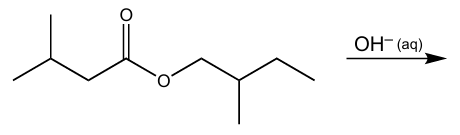
Name alcohol formed when the following ester undergoes a saponification reaction.
Saponification is a chemical reaction where an ester reacts with aqueous hydroxide ion () to break the ester bond. This cleavage produces two products: a carboxylate anion and an alcohol. Structurally, the bond between the carbonyl carbon and the ester oxygen is broken. The carbonyl side gains a negative charge on the oxygen, forming the carboxylate anion, which is the conjugate base of a carboxylic acid. Meanwhile, the other oxygen gains a hydrogen to regenerate the alcohol. This reaction is essentially the reverse of esterification, where esters are formed from carboxylic acids and alcohols. Understanding saponification is important in organic chemistry, especially in processes like soap making, where fats (esters) are hydrolyzed to produce soap (carboxylate salts) and glycerol (alcohol).
During saponification, an ester reacts with aqueous hydroxide ion () and the ester bond is cleaved. This reaction yields two main products: a carboxylate anion and an alcohol. The carboxylate anion is the conjugate base of a carboxylic acid, meaning it has lost a proton () and carries a negative charge on the oxygen atom. The other product is an alcohol, which forms when the oxygen originally part of the ester linkage gains a hydrogen atom. This cleavage is important because it reverses the esterification process and is widely used in organic synthesis and industrial applications such as soap production.
The hydroxide ion () acts as a nucleophile in the saponification reaction. It attacks the carbonyl carbon of the ester, which is electrophilic due to the partial positive charge on the carbon. This attack leads to the cleavage of the ester bond between the carbonyl carbon and the ester oxygen. As a result, the ester is split into two parts: the carboxylate anion and the alcohol. The hydroxide ion facilitates this bond breaking by providing the necessary nucleophilic attack and also contributes to the formation of the negatively charged carboxylate ion by deprotonating the carboxylic acid intermediate. This mechanism explains why saponification requires aqueous hydroxide and is considered a base-catalyzed hydrolysis.
The carboxylate ion formed during saponification is negatively charged because it is the conjugate base of a carboxylic acid. When the ester bond is cleaved by hydroxide ion (), the carbonyl carbon retains the oxygen atom, which gains a negative charge after losing a proton (). This loss of means the oxygen now carries an extra electron, resulting in a negative charge. This negatively charged oxygen stabilizes the carboxylate ion, making it more reactive and soluble in water. The formation of the carboxylate ion is a key feature of saponification and distinguishes it from esterification, where the carboxylic acid is protonated.
To identify the products after saponification, examine the original ester structure and locate the ester linkage between the carbonyl carbon and the oxygen atom. During saponification, this bond is cleaved. The side containing the carbonyl carbon becomes the carboxylate anion, as it gains a negative charge on the oxygen after losing a proton. The other side, which was attached to the ester oxygen, gains a hydrogen atom and becomes the alcohol. By tracing which part of the ester was connected to the carbonyl and which was connected to the oxygen, you can determine which product is the carboxylate and which is the alcohol. This approach helps in predicting the outcome of saponification reactions in organic synthesis.