Halogenation reactions add two halogen atoms across each pi bond of an unsaturated hydrocarbon using Br2 or Cl2. In an alkene, one mole of \(X_2\) adds across the double bond so that each double-bonded carbon gains one halogen, forming a dihalide .
For an alkyne, there are two pi bonds, so halogenation requires two moles of \(X_2\) to fully react. The first addition removes one pi bond, and the second addition removes the remaining pi bond, leaving a saturated product with four halogens total, called a tetrahalide . The key pattern is to count pi bonds and add two halogens per pi bond.
0
Concept
Halogenation Reactions
Video duration:
1m
Play a video:
Halogenation Reactions Video Summary
Halogenation reactions involve the addition of halogens, such as bromine (Br2) or chlorine (Cl2), to alkenes and alkynes. In the case of alkenes, which contain one pi bond, the reaction results in the formation of a dihalide. This occurs as each carbon atom involved in the double bond gains one halogen atom, leading to a final structure with two halogens.
For alkynes, which have two pi bonds, the process requires the addition of two moles of halogen reagent (X2). The first mole adds two halogens, and the second mole adds another two, resulting in a tetrahalide structure that contains four halogen atoms. Thus, the key takeaway is that halogenation adds two halogens for each pi bond present in the molecule, yielding either a dihalide from alkenes or a tetrahalide from alkynes.
Study Smarter with Worksheets.
Follow along with each video using our printable worksheets
0
Example
Halogenation Reactions Example
Video duration:
47s
Play a video:
Halogenation Reactions Example Video Summary
When an alkene undergoes halogenation with chlorine, the reaction involves the addition of two chlorine atoms across the double bond. In this process, the pi bond of the alkene is broken, allowing each carbon atom that was part of the double bond to form a new bond with a chlorine atom.
The general reaction can be represented as follows:
\[
\text{RCH=CHR} + \text{Cl}_2 \rightarrow \text{RCHCl-CHClR}
\]
In this equation, R represents the hydrocarbon chain or substituents attached to the double-bonded carbons. The resulting product is a dihalide, where each carbon that was originally part of the double bond now has a chlorine atom attached.
The orientation of the chlorine atoms (whether they are on the same side or opposite sides of the molecule) does not affect the completion of the reaction; what is crucial is that each carbon from the original double bond is bonded to a chlorine atom. This reaction does not delve into stereochemistry at this level, which will be explored in more advanced organic chemistry courses.
Thus, the final product of the halogenation reaction is a dihalide structure, represented as RCHCl-CHClR, indicating that each carbon from the original alkene has successfully bonded with a chlorine atom.
0
Problem
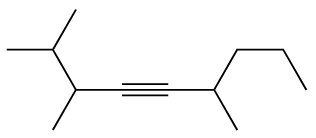
Write a halogenation reaction of the following alkyne with Br2 and name the product formed.
Halogenation reactions in alkenes involve the addition of elemental halogens, typically bromine (Br2) or chlorine (Cl2), across the carbon–carbon double bond. The pi bond in the alkene acts as a nucleophile and attacks the halogen molecule, leading to the formation of a cyclic halonium ion intermediate. Subsequently, a halide ion attacks the more substituted carbon, opening the ring and resulting in a vicinal dihalide where each carbon of the original double bond gains one halogen atom. This reaction is stereospecific and usually proceeds with anti addition, meaning the two halogens add to opposite faces of the double bond. The overall reaction can be summarized as: , where X represents a halogen.
Halogenation of alkynes differs from alkenes primarily because alkynes contain two pi bonds in their triple bond, whereas alkenes have only one pi bond. For each pi bond, one mole of halogen (X2) is required. Therefore, alkynes need two equivalents of halogen to fully react. The first equivalent adds across one pi bond, forming a dihalide intermediate with two halogens added. The second equivalent adds across the remaining pi bond, resulting in a tetrahalide where four halogen atoms are attached to the carbons originally involved in the triple bond. This converts the triple bond into a single bond. The overall reaction can be represented as: . This difference in stoichiometry and product formation is key when studying halogenation reactions.
In halogenation reactions, the products depend on whether the starting material is an alkene or an alkyne. For alkenes, the addition of one mole of halogen (X2) across the double bond results in a vicinal dihalide, where each carbon of the original double bond gains one halogen atom. This product is called a dihalide. For alkynes, which have two pi bonds, two moles of halogen are required. The first mole adds to form a dihalide intermediate, and the second mole adds again to produce a tetrahalide, where four halogen atoms are attached to the carbons that were originally triple bonded. The tetrahalide has single bonds between the carbons after full halogenation. Thus, the typical products are dihalides from alkenes and tetrahalides from alkynes.
The amount of halogen reagent is crucial in halogenation reactions because it determines the extent of addition across the pi bonds. Each pi bond in the starting molecule requires one mole of halogen (X2) to fully add halogen atoms. For alkenes, which have one pi bond, one mole of halogen is sufficient to produce a dihalide. For alkynes, which have two pi bonds, two moles of halogen are needed to fully convert the triple bond into a tetrahalide. Using less than the required amount results in partial halogenation, while excess halogen can lead to overreaction or side products. Therefore, stoichiometric control is essential to obtain the desired halogenated product.
The terms 'dihalide' and 'tetrahalide' describe the number of halogen atoms added to the carbon atoms involved in the original pi bonds during halogenation. A 'dihalide' refers to a compound where two halogen atoms are added across a double bond, one on each carbon, typical of alkene halogenation. A 'tetrahalide' refers to a compound where four halogen atoms are added across what was originally a triple bond in an alkyne, with two halogens attached to each carbon. These terms help in understanding the degree of halogenation and the structure of the final product after the reaction.