Monosubstituted benzenes are organic compounds where a benzene ring serves as the parent structure, featuring only one substituent. This simplicity in structure allows for straightforward naming conventions. When naming a monosubstituted benzene, the name of the substituent is placed before the term "benzene." For example, if the substituent is a methyl group, the compound is named "toluene." Since there is only one substituent, specifying its position on the benzene ring is unnecessary, making the naming process more efficient. Understanding this basic naming system is essential for further studies in organic chemistry, particularly in the context of aromatic compounds.
22. Organic Chemistry
Naming Benzene
22. Organic Chemistry
Naming Benzene: Videos & Practice Problems
Topic summary
Naming Benzene focuses on compounds where benzene is the parent chain. For a monosubstituted benzene, only one group is attached, so no location number is needed; the name is written as the substituent followed by benzene, such as an alkylbenzene. Common substituent names from branched alkyl groups may also appear, including groups like tert-butyl or isopropyl when they are attached directly to the ring.
For a disubstituted benzene, two substituents are attached to the ring. The substituents are assigned numbers in alphabetical order, and the ring is numbered to give the second substituent the lowest possible position. These compounds can be named with numbers such as 1,2-, 1,3-, or 1,4-, or with the positional terms ortho, meta, and para. A 1,2 relationship is ortho, 1,3 is meta, and 1,4 is para. When the two substituents are identical, prefixes such as di- are used, as in diethylbenzene or dichlorobenzene.
0
Concept
Monosubstituted Benzene

Video duration:
30sMonosubstituted Benzene Video Summary
Study Smarter with Worksheets.
Follow along with each video using our printable worksheets

0
Example
Naming Benzene Example
Video duration:
48sNaming Benzene Example Video Summary
In organic chemistry, naming compounds systematically is essential for clear communication. When dealing with compounds that contain a benzene ring and an alkyl group, the structure of the alkyl group plays a crucial role in determining the correct name.
In this example, we have a benzene ring connected to an alkyl group consisting of four carbon atoms. The possible names for this alkyl group include butyl, isobutyl, sec-butyl, and tert-butyl. To identify the correct name, we examine the structure of the alkyl group. In this case, the connection occurs at a carbon that is bonded to three methyl groups, which indicates that the alkyl group is a tert-butyl group.
Thus, the systematic name of the compound is formed by combining the name of the alkyl group with the name of the benzene ring. The correct name is tert-butylbenzene, where "tert-butyl" is hyphenated to indicate the specific structure of the alkyl group attached to the benzene.
0
Concept
Disubstituted Benzene
Video duration:
2mDisubstituted Benzene Video Summary
Disubstituted benzenes are aromatic compounds where a benzene ring serves as the parent structure, featuring two substituents. The naming of these compounds follows a systematic approach where substituents are numbered based on alphabetical order. For instance, if the substituents are fluorine and bromine, bromine (bromo) is prioritized, and the numbering begins at its position.
When naming disubstituted benzenes, the locations of each substituent are indicated numerically, followed by the term "benzene." Additionally, the positions of the substituents can be described using the terms ortho, meta, and para, which correspond to specific arrangements on the benzene ring. In this context, the positions are defined as follows: ortho (1,2), meta (1,3), and para (1,4).
For example, in dichlorobenzenes, if the chlorines occupy the 1,2 positions, the compound can be referred to as either 1,2-dichlorobenzene or ortho-dichlorobenzene. If the chlorines are in the 1,3 positions, it is called 1,3-dichlorobenzene or meta-dichlorobenzene. Lastly, if they are in the 1,4 positions, it is designated as 1,4-dichlorobenzene or para-dichlorobenzene.
It is important to note that the two substituents can be identical or different, and the ortho, meta, and para nomenclature remains applicable in both cases. A helpful mnemonic to remember the order of these terms is "Order More Pizza," where "Order" represents ortho (1,2), "More" signifies meta (1,3), and "Pizza" indicates para (1,4). This memory aid can assist in recalling the positional designations when naming disubstituted benzenes.
0
Example
Naming Benzene Example
Video duration:
1mNaming Benzene Example Video Summary
In organic chemistry, naming compounds systematically is essential for clear communication. In this example, we have a compound featuring a benzene ring bonded to two ethyl groups, which are two-carbon alkyl chains. When determining the systematic name, we can start numbering the carbon positions on the benzene ring from either side since both ethyl groups are identical. This results in the positions 1 and 3 being occupied by the ethyl groups.
The systematic name is derived by indicating the positions of the substituents, the number of identical groups, and the base name of the aromatic compound. Here, we have two ethyl groups at positions 1 and 3, leading to the designation "di" for two identical substituents. Therefore, the systematic name of the compound is 1,3-Diethylbenzene.
Additionally, there is a common naming convention using the terms ortho, meta, and para to describe the relative positions of substituents on the benzene ring. In this case, since the ethyl groups are located at positions 1 and 3, the common name would be meta-diethylbenzene. This alternative naming method provides a different perspective on the compound's structure, although the systematic name remains the official designation.
0
Problem
Determine the systematic name of the molecule.
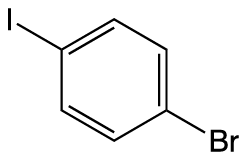
A
1-iodo-4-bromobenzene
B
1-bromo-4-iodobenzene
C
4-bromo-1-iodobenzene
D
4-iodo-1-bromobenzene
0
Problem
Determine the systematic name of the molecule.
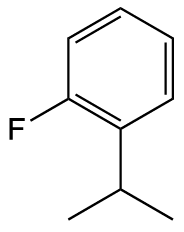
A
ortho-fluoroisopropylbenzene
B
para-fluoroisopropylbenzene
C
meta-fluoroisopropylbenzene
D
1-fluoro-2-tert-butylbenzene
Do you want more practice?
More setsNaming Benzene
22. Organic Chemistry
6 problems
Topic

Jules
22. Organic Chemistry - Part 1 of 6
7 topics 14 problems
Chapter
Jules
22. Organic Chemistry - Part 2 of 6
5 topics 14 problems
Chapter
Jules
22. Organic Chemistry - Part 3 of 6
6 topics 14 problems
Chapter

Keyshawn
22. Organic Chemistry - Part 4 of 6
8 topics 13 problems
Chapter
Jules
22. Organic Chemistry - Part 5 of 6
8 topics 14 problems
Chapter
Jules
22. Organic Chemistry - Part 6 of 6
4 topics 12 problems
Chapter
Jules
Go over this topic definitions with flashcards
More setsHere's what students ask on this topic:
To name a monosubstituted benzene, you identify benzene as the parent chain with only one substituent attached. Since there is only one substituent, you do not need to specify its position on the ring. The naming convention is straightforward: you write the name of the substituent followed by the word "benzene." For example, if a methyl group is attached, the compound is named "methylbenzene." Similarly, if a chlorine atom is attached, it is called "chlorobenzene." This simplicity arises because the benzene ring is symmetrical, so the position of a single substituent does not affect the name.
In disubstituted benzene compounds, where two substituents are attached to the benzene ring, the substituents are numbered to give the lowest possible numbers. The numbering starts with the substituent that comes first alphabetically, which is assigned position 1. Then, the ring is numbered in the direction that gives the second substituent the lowest possible number. For example, if the substituents are bromine and fluorine, "bromo" comes before "fluoro" alphabetically, so bromine is at position 1. The second substituent's position is then chosen to minimize the number, such as 2 or 3. This systematic numbering ensures consistent and clear naming of disubstituted benzenes.
The terms ortho, meta, and para are common positional descriptors used to indicate the relative positions of two substituents on a benzene ring. Ortho (abbreviated as "o-") means the substituents are adjacent, at positions 1 and 2. Meta ("m-") means the substituents are separated by one carbon, at positions 1 and 3. Para ("p-") means the substituents are opposite each other, at positions 1 and 4. These terms provide a convenient alternative to numerical locants. For example, 1,2-dichlorobenzene can also be called ortho-dichlorobenzene. This naming convention works whether the substituents are identical or different and is widely used in organic chemistry.
Yes, both numerical locants and the ortho/meta/para system can be used to name disubstituted benzenes. Numerical locants specify the exact carbon positions of the substituents on the benzene ring, such as 1,2-, 1,3-, or 1,4-. The ortho/meta/para terms correspond to these positions: ortho for 1,2-, meta for 1,3-, and para for 1,4-. For example, 1,2-dibromobenzene can also be named ortho-dibromobenzene. Both naming methods are correct, and the choice depends on context or preference. The ortho/meta/para system is often used for simplicity and ease of communication, especially when the substituents are common groups.
In naming disubstituted benzenes, the substituent that comes first alphabetically is assigned position 1 on the benzene ring. This alphabetical rule helps standardize the numbering system. After assigning position 1 to the first substituent alphabetically, the ring is numbered in the direction that gives the second substituent the lowest possible number. For example, if the substituents are bromine and fluorine, "bromo" comes before "fluoro," so bromine is at position 1. This method ensures consistent and unambiguous naming of compounds with two substituents.