Ch.9 - Thermochemistry: Chemical Energy
McMurry - Chemistry 8th Edition
McMurry8th EditionChemistryISBN: 9781292336145Not the one you use?Change textbook
Chapter 9, Problem 79

Titanium metal is used as a structural material in many high-tech applications, such as in jet engines. what is the specific heat of titanium in J/(g·°C) if it takes 89.7 J to raise the temeprature of a 33.0 g block of 5.20 °C? What is the molar heat capacity of titanium J/(mol·°C)?

Verified step by step guidance
1
Identify the given values: heat energy (Q) = 89.7 J, mass (m) = 33.0 g, and temperature change (ΔT) = 5.20 °C.
Use the formula for specific heat capacity (c), which is c = Q / (m * ΔT). Plug in the values to find the specific heat of titanium.
To find the molar heat capacity, first determine the molar mass of titanium. Titanium (Ti) has an atomic mass of approximately 47.87 g/mol.
Calculate the number of moles of titanium in the 33.0 g block using the formula: moles = mass / molar mass.
Use the formula for molar heat capacity (C), which is C = Q / (moles * ΔT). Calculate the molar heat capacity using the values obtained from the previous steps.

Verified video answer for a similar problem:

This video solution was recommended by our tutors as helpful for the problem above.
Video duration:
2m
Was this helpful?

Key Concepts

Here are the essential concepts you must grasp in order to answer the question correctly.

Specific Heat Capacity

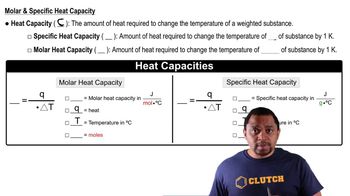
Specific heat capacity is the amount of heat required to raise the temperature of one gram of a substance by one degree Celsius. It is a crucial property that helps in understanding how substances respond to heat. The formula to calculate specific heat (c) is c = q / (m × ΔT), where q is the heat added, m is the mass, and ΔT is the change in temperature.
Recommended video:
Guided course
02:19
Heat Capacity

Molar Heat Capacity

Molar heat capacity is the amount of heat required to raise the temperature of one mole of a substance by one degree Celsius. It is related to specific heat capacity but is expressed per mole rather than per gram. The relationship between specific heat and molar heat capacity can be established using the molar mass of the substance, allowing for conversions between the two.
Recommended video:
Guided course
02:19
Heat Capacity

Heat Transfer

Heat transfer refers to the movement of thermal energy from one object or substance to another due to a temperature difference. In the context of the question, it involves calculating how much energy is needed to change the temperature of titanium. Understanding heat transfer is essential for applying the concepts of specific and molar heat capacities in practical scenarios.
Recommended video:
Guided course
02:19
Heat Capacity
Related Practice
Textbook Question
A reactiont akes place at a constant pressure of 1.10 atm with an internal energy change (ΔE) of 71.5 kJ and a volume decrease of 13.6 L. What is the enthalpy change (ΔH) for the reaction? (1 L-atm = 101.325 J)
1073
views

Textbook Question
Assuming that Coca-Cola has the saem specific heat as water [4.18 J/(g C)], calculate the amount of heat in kilojoules transferred when one can (about 350 g) is cooled from 25 C to 3 C.
1345
views
Textbook Question
What is the enthalpy change (ΔH) for a reaction at a constant pressure of 1.00 atm fi the internal energy chagne (ΔE) is 44.0 kJ and the volume increase is 14.0 L? (1 L-atm = 101.325 J)
1611
views
Textbook Question
Instant cold packs used to treat athletic injuries contain solid NH4NO3 and a pouch of water. When the pack is squeezed, the pouch breaks and the solid dissolves, lowering the tem-perature because of the endothermic reaction NH4NO31s2 ¡ NH4NO31aq2 ∆H = +25.7 kJ What is the final temperature in a squeezed cold pack that contains 50.0 g of NH4NO3 dissolved in 125 mL of water? Assume a specific heat of 4.18 J/(g C) for the solution, an initial temperature of 25.0 °C, and no heat transfer between the cold pack and the environment.
1652
views
Textbook Question
Sodium metal is sometimes used as a cooling agent in heat-exchange units because of its releatively high molar heat capacity fo 28.2 J/(mol·°C). What is the specific heat and molar heat capacity of sodium in J/g·°C?
1007
views
Textbook Question
Calculate the amount of heat required to raise the tempera- ture of 250.0 g (approximately 1 cup) of hot chocolate from 25.0 °C to 80.0 °C. Assume hot chocolate has the same spe-cific heat as water 34.18 J>1g °C24.
1398
views