Join thousands of students who trust us to help them ace their exams!
Multiple Choice
How much energy (kJ) is required to convert a 76.4 g acetone (MM = 58.08 g/mol) as a liquid at -30°C to a solid at -115.0°C?
A
-11.406 kJ
B
-39.820 kJ
C
-22.811 kJ
D
-82.592 kJ
5 Comments
Verified step by step guidance
1
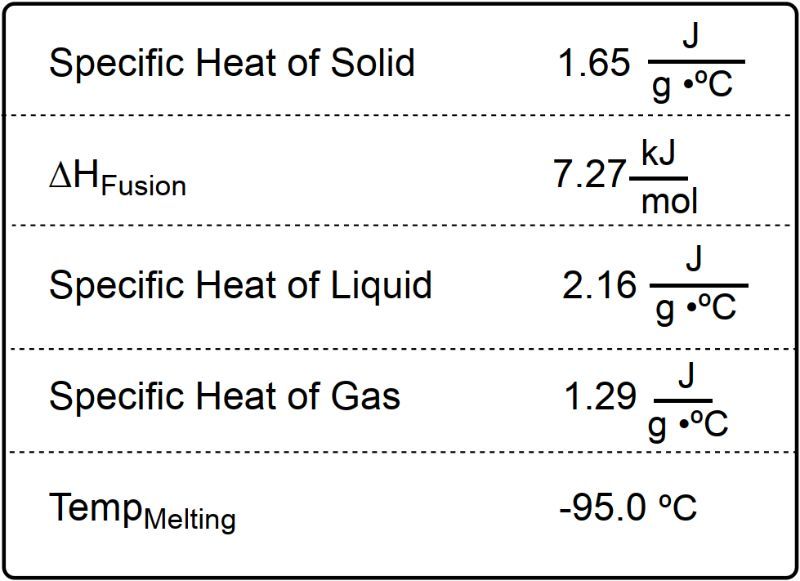
Step 1: Identify the phases and temperature changes involved. The acetone starts as a liquid at -30°C and ends as a solid at -115.0°C. This means it must first be cooled from -30°C to its melting point (-95.0°C), then solidify (freeze), and finally be cooled further from -95.0°C to -115.0°C.
Step 2: Calculate the moles of acetone using its mass and molar mass: \(\text{moles} = \frac{76.4\, \text{g}}{58.08\, \text{g/mol}}\).
Step 3: Calculate the energy required to cool the liquid acetone from -30°C to -95.0°C using the specific heat of the liquid: \(q_1 = m \times C_{liquid} \times \Delta T = 76.4\, \text{g} \times 2.16\, \frac{J}{g\cdot ^\circ C} \times (-95.0 - (-30))^\circ C\).
Step 4: Calculate the energy released during the phase change (freezing) at the melting point using the enthalpy of fusion: \(q_2 = \text{moles} \times (-\Delta H_{fusion}) = \text{moles} \times (-7.27\, \frac{kJ}{mol})\). Note the negative sign because freezing releases energy.
Step 5: Calculate the energy required to cool the solid acetone from -95.0°C to -115.0°C using the specific heat of the solid: \(q_3 = m \times C_{solid} \times \Delta T = 76.4\, \text{g} \times 1.65\, \frac{J}{g\cdot ^\circ C} \times (-115.0 - (-95.0))^\circ C\).
Step 6: Sum all the energy changes: \(q_{total} = q_1 + q_2 + q_3\). Convert all energies to the same units (kJ) before summing.


 Verified step by step guidance

