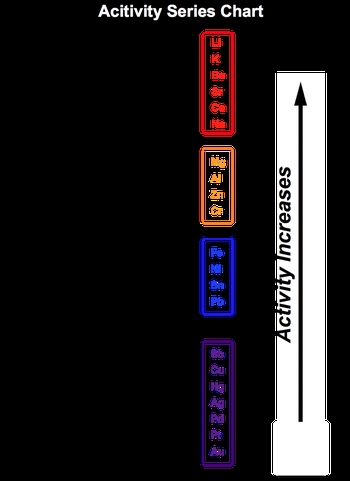
The activity series is a crucial tool in understanding the reactivity of metals and their ability to displace other elements in chemical reactions. As you move up the activity series chart, the strength of reactivity increases. The top group, highlighted in red, includes lithium, potassium, barium, strontium, calcium, and sodium. These metals are capable of displacing any elements located below them in the series. Notably, lithium, being the highest in this group, can displace all other elements beneath it.
A key feature of the activity series is the presence of hydrogen gas, which acts as a boundary. Elements positioned below hydrogen in the series cannot displace it from compounds. For instance, if hydrogen is bonded with another element, those lower elements cannot replace hydrogen in a reaction.
When considering how certain metals can displace hydrogen, it is important to note that the first group can do so in various forms: liquid water, water vapor (steam), or in acidic solutions represented as H3O+. This means that metals like lithium and potassium can effectively replace hydrogen in these states. As you descend the activity series, the ability to displace hydrogen diminishes. For example, metals lower in the series can only displace hydrogen when it is present in liquid water or as a gas, while even lower metals can only displace hydrogen from acidic solutions.
Understanding the activity series allows for predicting the outcomes of displacement reactions, emphasizing the importance of the position of each element within the series. This knowledge is essential for analyzing chemical reactivity and the potential for displacement in various chemical contexts.