Join thousands of students who trust us to help them ace their exams!
Multiple Choice
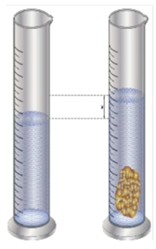
A piece of unknown solid weighs approximately 0.23 lbs. When a scientist places it in a glass beaker the water level increases from 200 mL to 260 mL. What is the density of the unknown solid in g/mL?
A
5 g/mL
B
4 g/mL
C
7 g/mL
D
3 g/mL
E
2 g/mL
4 Comments
Verified step by step guidance
1
First, convert the weight of the solid from pounds (lbs) to grams (g) because density is typically expressed in grams per milliliter (g/mL). Use the conversion factor: 1 lb = 453.592 g. So, multiply 0.23 lbs by 453.592 to get the mass in grams.
Next, determine the volume of the solid by finding the difference in water levels before and after placing the solid in the beaker. The initial volume is 200 mL and the final volume is 260 mL, so the volume of the solid is 260 mL - 200 mL.
Now, calculate the density of the solid using the formula for density: \(\text{Density} = \frac{\text{Mass}}{\text{Volume}}\). Use the mass in grams and the volume in milliliters obtained from the previous steps.
Substitute the values of mass (in grams) and volume (in milliliters) into the density formula to set up the calculation.
Finally, perform the division to find the density in g/mL. This value will tell you how dense the unknown solid is compared to water.


 Verified step by step guidance

