The hydrated cation M1H2O26 3 + has Ka = 10-4, and the acid HA has Ka = 10-5. Identify the principal reaction in an aqueous solution of each of the following salts, and classify each solution as acidic, basic, or neutral. (a) NaA
Verified step by step guidance
1
Step 1: Identify the components of the salt NaA.
Step 2: Recognize that NaA is composed of Na^+ and A^-.
Step 3: Determine the nature of Na^+. Since Na^+ is the cation of a strong base (NaOH), it does not affect the pH and is considered neutral.
Step 4: Analyze the anion A^-. Since A^- is the conjugate base of the weak acid HA (with K_a = 10^{-5}), it can accept protons and thus will make the solution basic.
Step 5: Conclude that the principal reaction in the solution is the hydrolysis of A^-: A^- + H_2O \rightleftharpoons HA + OH^-, making the solution basic.
Verified video answer for a similar problem:
This video solution was recommended by our tutors as helpful for the problem above.
Video duration:
2m
Play a video:
Was this helpful?
Key Concepts
Here are the essential concepts you must grasp in order to answer the question correctly.
Hydrated Cations and Their Acidity
Hydrated cations, such as M1H2O26 3+, can act as acids in solution by donating protons (H+) to water, leading to the formation of hydronium ions (H3O+). The strength of this acidic behavior is quantified by the acid dissociation constant (Ka), which indicates how readily the cation donates protons. A higher Ka value signifies a stronger acid, influencing the pH of the solution.
Acid-base equilibria describe the balance between acids and bases in a solution, governed by their respective Ka values. In this context, the acid HA with a Ka of 10-5 is weaker than the hydrated cation M1H2O26 3+ with a Ka of 10-4. This difference in strength determines the predominant species in solution and helps classify the resulting solution as acidic, basic, or neutral based on the concentration of H3O+ ions.
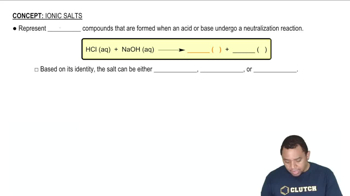
Salt hydrolysis occurs when a salt dissolves in water and its constituent ions interact with water molecules, potentially altering the pH of the solution. For example, the salt NaA dissociates into Na+ and A- ions. The A- ion, being the conjugate base of the weak acid HA, can accept protons from water, leading to an increase in hydroxide ions (OH-) and resulting in a basic solution.