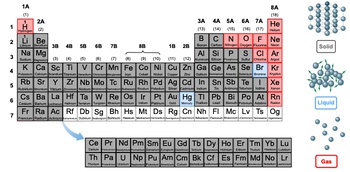

In this scenario, we are tasked with identifying a representative element from the second period of the periodic table that is not diatomic and assumes the shape and volume of its container. Understanding the classification of elements is crucial; representative elements are those that are not transition metals, which helps narrow down our options. In the second period, we find elements such as beryllium, boron, carbon, nitrogen, oxygen, fluorine, neon, and argon. Among these, beryllium, boron, carbon, and silicon are monoatomic, while nitrogen, oxygen, fluorine, and neon are gases.
The key phrase in the question is that the element "assumes the shape and volume of the container," indicating that it must be a gas. In the second period, the gaseous elements are nitrogen (N), oxygen (O), fluorine (F), and neon (Ne). However, since we are looking for a representative element that is not diatomic, we can eliminate nitrogen (N) and oxygen (O) as they exist as diatomic molecules (N2 and O2 respectively). This leaves us with fluorine (F) and neon (Ne).
Fluorine is also diatomic (F2), which means the only option that fits all criteria is neon (Ne). Neon is a noble gas, known for being monoatomic and existing in a gaseous state at room temperature. Therefore, the correct answer to the question is neon (option d), as it perfectly meets all the specified conditions.