Consider the following gases, all at STP: Ne, SF6, N2, CH4. (d) Which one has the highest total molecular volume relative to the space occupied by the gas?
Ch.10 - Gases
Brown14th EditionChemistry: The Central ScienceISBN: 9780134414232Not the one you use?Change textbook
Chapter 10, Problem 112
You have a sample of gas at 0 C. You wish to increase the rms speed by a factor of 3. To what temperature should the gas be heated?
Verified step by step guidance1
Identify the initial temperature in Kelvin. Since the given temperature is 0°C, convert it to Kelvin by adding 273.15.
Recognize that the root mean square (rms) speed of a gas is proportional to the square root of its temperature. The formula relating rms speed and temperature is \( v_{rms} \propto \sqrt{T} \).
Set up the proportionality equation for the rms speeds before and after the temperature change. If the initial rms speed is \( v_{rms, initial} \) and the final rms speed is \( v_{rms, final} = 3 \times v_{rms, initial} \), then \( \frac{v_{rms, final}}{v_{rms, initial}} = \frac{\sqrt{T_{final}}}{\sqrt{T_{initial}}} \).
Solve the proportionality equation for \( T_{final} \). Since \( \frac{v_{rms, final}}{v_{rms, initial}} = 3 \), square both sides to remove the square root, resulting in \( \frac{T_{final}}{T_{initial}} = 9 \).
Calculate the final temperature, \( T_{final} \), by multiplying the initial temperature in Kelvin by 9.

Verified video answer for a similar problem:
This video solution was recommended by our tutors as helpful for the problem above.
Video duration:
2mKey Concepts
Here are the essential concepts you must grasp in order to answer the question correctly.
Root Mean Square Speed (rms speed)
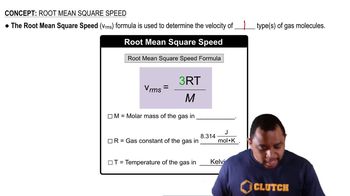
The root mean square speed is a measure of the average speed of gas particles in a sample. It is calculated using the formula v_rms = √(3RT/M), where R is the ideal gas constant, T is the absolute temperature in Kelvin, and M is the molar mass of the gas. This concept is crucial for understanding how temperature affects the kinetic energy and speed of gas molecules.
Recommended video:
Guided course
Root Mean Square Speed Formula
Temperature and Kinetic Energy
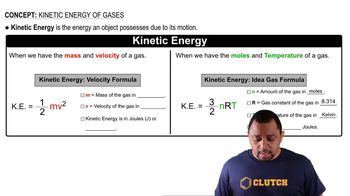
Temperature is a measure of the average kinetic energy of the particles in a substance. In gases, as temperature increases, the kinetic energy of the molecules also increases, leading to higher speeds. This relationship is fundamental in determining how much the temperature must be raised to achieve a desired increase in rms speed.
Recommended video:
Guided course
Kinetic Energy Formulas
Ideal Gas Law
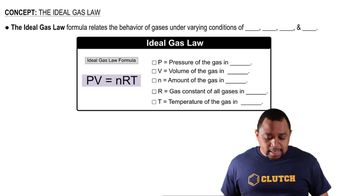
The Ideal Gas Law, represented as PV = nRT, relates the pressure (P), volume (V), number of moles (n), gas constant (R), and temperature (T) of an ideal gas. This law provides a framework for understanding the behavior of gases under various conditions and is essential for calculating changes in temperature when manipulating other variables, such as speed.
Recommended video:
Guided course
Ideal Gas Law Formula
Related Practice
Textbook Question
626
views
Textbook Question
Consider the following gases, all at STP: Ne, SF6, N2, CH4. (a) Which gas is most likely to depart from the assumption of the kinetic-molecular theory that says there are no attractive or repulsive forces between molecules?
1083
views
Textbook Question
The density of a gas of unknown molar mass was measured as a function of pressure at 0 C, as in the table that follows. (a) Determine a precise molar mass for the gas. [Hint: Graph d>P versus P.]
936
views
Textbook Question
The density of a gas of unknown molar mass was measured as a function of pressure at 0 C, as in the table that follows. (b) Why is d>P not a constant as a function of pressure?
619
views