
Ch.8 - Covalent Compounds: Bonding Theories and Molecular Structure
McMurry - Chemistry 8th Edition
McMurry8th EditionChemistryISBN: 9781292336145Not the one you use?Change textbook
Chapter 8, Problem 97

For a given type of MO, use a s2s as an example, is the bonding or antibonding orbital higher in energy? Explain.

Verified step by step guidance
1
Step 1: Understand the concept of Molecular Orbitals (MO). Molecular Orbitals are formed by the combination of atomic orbitals. When atomic orbitals combine, they form two new orbitals: a bonding orbital and an antibonding orbital.
Step 2: The bonding orbital is formed by the constructive interference of atomic orbitals, which leads to an increase in electron density between the nuclei. This results in a decrease in energy and thus, the bonding orbital is lower in energy.
Step 3: The antibonding orbital, on the other hand, is formed by the destructive interference of atomic orbitals, which leads to a decrease in electron density between the nuclei. This results in an increase in energy and thus, the antibonding orbital is higher in energy.
Step 4: Therefore, for a given type of MO, such as s2s, the antibonding orbital is higher in energy than the bonding orbital.
Step 5: This is because the antibonding orbital is associated with electron repulsion, which increases the energy of the system, while the bonding orbital is associated with electron attraction, which decreases the energy of the system.

Verified video answer for a similar problem:

This video solution was recommended by our tutors as helpful for the problem above.
Video duration:
2m
Was this helpful?

Key Concepts

Here are the essential concepts you must grasp in order to answer the question correctly.

Molecular Orbitals (MOs)

Molecular orbitals are formed by the linear combination of atomic orbitals when atoms bond together. They can be classified as bonding or antibonding orbitals. Bonding orbitals are lower in energy and stabilize the molecule, while antibonding orbitals are higher in energy and can destabilize the molecule if occupied.
Recommended video:
Guided course
03:06
Molecular Orbital Theory

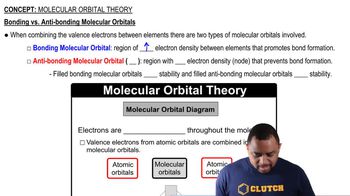
Bonding vs. Antibonding Orbitals

Bonding orbitals result from the constructive interference of atomic orbitals, leading to increased electron density between the nuclei, which stabilizes the molecule. In contrast, antibonding orbitals arise from destructive interference, resulting in a node between the nuclei and higher energy, making them less stable when occupied.
Recommended video:
Guided course
03:06
Molecular Orbital Theory

Energy Levels of Orbitals

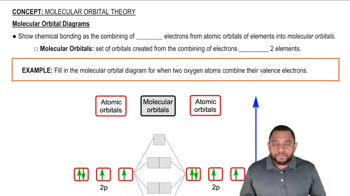
In molecular orbital theory, the energy levels of bonding and antibonding orbitals are distinct, with bonding orbitals being lower in energy than their corresponding antibonding orbitals. For example, in a simple diatomic molecule like H2, the bonding orbital (σ) is lower in energy than the antibonding orbital (σ*), which is crucial for understanding molecular stability and reactivity.
Recommended video:
Guided course
04:12
Molecular Orbital Diagram