
Textbook Question
Why don't all collisions between reactant molecules lead to a chemical reaction?
637
views

 Verified step by step guidance
 02:02
02:02
 02:03
02:03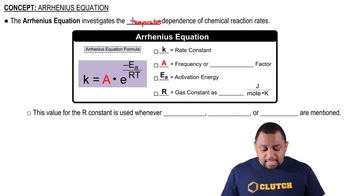 01:20
01:20Consider the following concentration–time data for the decomposition reaction AB → A + B.
(b) What is the molarity of AB after a reaction time of 192 min?
Consider three reactions with different values of Ea and ΔE:
Reaction 1. Ea = 20 kJ>mol; ΔE = -60 kJ/mol
Reaction 2. Ea = 10 kJ>mol; ΔE = -20 kJ/mol
Reaction 3. Ea = 40 kJ>mol; ΔE = +15 kJ/mol
(c) Which reaction is the most endothermic, and which is the most exothermic?
Consider three reactions with different values of Ea and ΔE:
Reaction 1. Ea = 20 kJ>mol; ΔE = -60 kJ/mol
Reaction 2. Ea = 10 kJ>mol; ΔE = -20 kJ/mol
Reaction 3. Ea = 40 kJ>mol; ΔE = +15 kJ/mol
(b) Assuming that all three reactions are carried out at the same temperature and that all three have the same frequency factor A, which reaction is the fastest and which is the slowest?