
Ch.5 - Periodicity & Electronic Structure of Atoms
McMurry - Chemistry 8th Edition
McMurry8th EditionChemistryISBN: 9781292336145Not the one you use?Change textbook
Chapter 5, Problem 126a

Imagine a universe in which the four quantum numbers can have the same possible values as in our universe except that the angular-momentum quantum number l can have integral values of 0, 1, 2...n + 1 (instead of 0, 1, 2..., n - 1). (a) How many elements would be in the first two rows of the periodic table in this universe?

Verified step by step guidance
1
Identify the maximum value of the angular momentum quantum number (l) for each principal quantum number (n). In this universe, l can range from 0 to n+1 for each n.
Calculate the total number of orbitals for each value of n by summing the orbitals contributed by each possible l value. The formula for the number of orbitals for a given l is (2l + 1).
For n=1, calculate the total number of orbitals by considering l values 0 and 1. For n=2, consider l values 0, 1, and 2.
Multiply the total number of orbitals for each n by 2 to account for the two possible spin states (m_s = +1/2 and -1/2) of an electron in each orbital.
Sum the total number of electrons that can be accommodated in the first two energy levels (n=1 and n=2) to determine the number of elements in the first two rows of the periodic table in this hypothetical universe.

Key Concepts

Here are the essential concepts you must grasp in order to answer the question correctly.

Quantum Numbers

Quantum numbers are sets of numerical values that describe the unique quantum state of an electron in an atom. There are four quantum numbers: the principal quantum number (n), the angular momentum quantum number (l), the magnetic quantum number (m_l), and the spin quantum number (m_s). Each quantum number provides specific information about the energy level, shape, orientation, and spin of the electron's orbital.
Recommended video:
Guided course
02:55
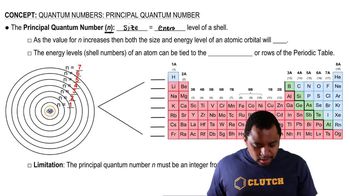
Principal Quantum Number

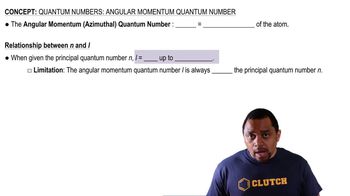
Angular Momentum Quantum Number (l)

The angular momentum quantum number (l) determines the shape of an electron's orbital and can take on integer values from 0 to n-1 in our universe. In the hypothetical scenario presented, l can take values from 0 to n+1, which expands the possible shapes of orbitals. This change affects the number of available orbitals and, consequently, the number of electrons that can occupy those orbitals.
Recommended video:
Guided course
00:40
Angular Momentum Quantum Number

Periodic Table and Electron Configuration

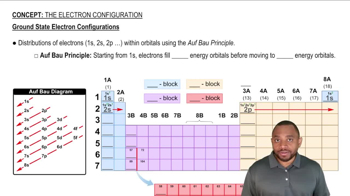
The periodic table organizes elements based on their electron configurations, which are determined by the distribution of electrons in atomic orbitals. Each row (or period) corresponds to a principal quantum number (n), and the number of elements in each period is influenced by the maximum number of electrons that can occupy the available orbitals. Understanding how changes in quantum numbers affect electron configurations is essential for predicting the number of elements in the periodic table.
Recommended video:
Guided course
07:14
Periodic Table Blocks
Related Practice
Textbook Question
Orbital energies in single-electron atoms or ions, such as He+, can be described with an equation similar to the Balmer–Rydberg equation:

where Z is the atomic number. What wavelength of light in nanometers is emitted when the electron in He+ falls from n = 3 to n = 2?
698
views
Textbook Question
Why do the Earth and Sun have different emission spectra?
646
views
Textbook Question
The amount of energy necessary to remove an electron from an atom is a quantity called the ionization energy, Ei. This energy can be measured by a technique called photoelectron spectroscopy, in which light of wavelength l is directed at an atom, causing an electron to be ejected. The kinetic energy of the ejected electron (Ek) is measured by determining its veloc-ity, v (Ek = mv2/2), and Ei is then calculated using the conservation of energy principle. That is, the energy of the incident light equals Ei plus Ek. What is the ionization energy of selenium atoms in kilojoules per mole if light with l = 48.2 nm produces electrons with a velocity of 2.371 * 106 m/s? The mass, m, of an electron is 9.109 * 10-31 kg.
2744
views
Textbook Question

Order the following atoms according to increasing atomic radius: Rb, Cl, As, K.

1099
views
Textbook Question
One watt (W) is equal to 1 J/s. Assuming that 5.0% of the energy output of a 75 W light bulb is visible light and that the average wavelength of the light is 550 nm, how many photons are emitted by the light bulb each second?
912
views
1
rank
Textbook Question
Microwave ovens work by irradiating food with microwave radiation, which is absorbed and converted into heat. Assum-ing that radiation with l = 15.0 cm is used, that all the energy is converted to heat, and that 4.184 J is needed to raise the temperature of 1.00 g of water by 1.00 °C, how many photons are necessary to raise the temperature of a 350 mL cup of water from 20 °C to 95 °C?
742
views