Show how Friedel–Crafts acylation might be used to synthesize the following compounds. c. n-butylbenzene
Verified step by step guidance
1
Step 1: Understand the Friedel–Crafts acylation reaction. This reaction involves the introduction of an acyl group (RCO-) into an aromatic ring using an acyl halide (RCOCl) and a Lewis acid catalyst, such as AlCl₃. The product is an aromatic ketone.
Step 2: Identify the target compound, n-butylbenzene. This compound consists of a benzene ring attached to a straight-chain butyl group (CH₂CH₂CH₂CH₃). Note that Friedel–Crafts acylation cannot directly introduce an alkyl group, but it can introduce an acyl group, which can later be reduced to an alkyl group.
Step 3: Choose the appropriate acyl halide for the reaction. To synthesize n-butylbenzene, you need to introduce a butanoyl group (CH₃CH₂CH₂CO-) onto the benzene ring. The acyl halide to use is butanoyl chloride (CH₃CH₂CH₂COCl).
Step 4: Perform the Friedel–Crafts acylation. React benzene with butanoyl chloride in the presence of a Lewis acid catalyst, such as AlCl₃. This will yield butanophenone (C₆H₅COCH₂CH₂CH₃), an aromatic ketone.
Step 5: Reduce the ketone to an alkyl group. Use a reducing agent such as zinc amalgam (Zn/Hg) in concentrated HCl (Clemmensen reduction) or hydrazine (NH₂NH₂) with a base (Wolff–Kishner reduction) to convert the butanophenone into n-butylbenzene (C₆H₅CH₂CH₂CH₂CH₃).
Verified video answer for a similar problem:
This video solution was recommended by our tutors as helpful for the problem above
Video duration:
2m
Play a video:
Was this helpful?
Key Concepts
Here are the essential concepts you must grasp in order to answer the question correctly.
Friedel–Crafts Acylation
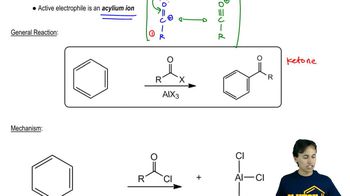
Friedel–Crafts acylation is an electrophilic aromatic substitution reaction that introduces an acyl group into an aromatic ring. This reaction typically involves the use of an acyl chloride and a Lewis acid catalyst, such as aluminum chloride, to generate the acylium ion, which then reacts with the aromatic compound. The result is a ketone that retains the aromatic character of the starting material.
Electrophilic aromatic substitution (EAS) is a fundamental reaction in organic chemistry where an electrophile replaces a hydrogen atom on an aromatic ring. The aromatic system's stability allows it to undergo substitution rather than addition, preserving its aromaticity. Understanding the mechanism of EAS is crucial for predicting the outcomes of reactions involving aromatic compounds, such as the Friedel–Crafts acylation.
n-Butylbenzene is an aromatic compound consisting of a benzene ring substituted with a butyl group. The presence of the butyl group influences the reactivity and orientation of further substitutions on the aromatic ring. In the context of Friedel–Crafts acylation, the n-butyl group can direct the acylation to specific positions on the benzene ring, affecting the final product's structure and properties.