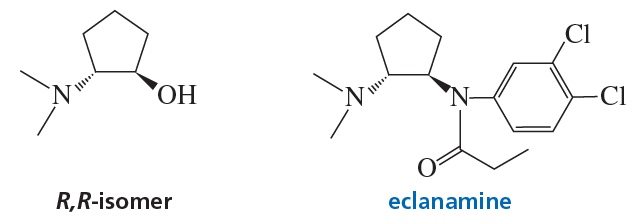
Two stereoisomers are obtained from the reaction of cyclopentene oxide and dimethylamine. The R,R-isomer is used in the manufacture of eclanamine, an antidepressant. What other isomer is obtained?
Verified step by step guidance
1
Understand the reaction: Cyclopentene oxide is an epoxide, which is a three-membered cyclic ether. When it reacts with dimethylamine, the reaction involves a nucleophilic ring-opening mechanism. Dimethylamine acts as the nucleophile, attacking the less sterically hindered carbon of the epoxide ring.
Analyze the stereochemistry: Epoxide ring-opening reactions are stereospecific. The nucleophile attacks the epoxide carbon in an anti (opposite) fashion relative to the leaving group (oxygen). This results in inversion of configuration at the carbon where the nucleophile attacks.
Determine the products: Since the starting material is cyclopentene oxide, the reaction will yield two stereoisomers. The R,R-isomer is one of the products, as stated in the problem. The other product will be the enantiomer of the R,R-isomer, which is the S,S-isomer. Enantiomers are non-superimposable mirror images of each other.
Verify the mechanism: The reaction proceeds via an SN2-like mechanism, where the nucleophile (dimethylamine) attacks the less hindered carbon of the epoxide, leading to inversion of configuration. This ensures that the stereochemistry of the products is consistent with the anti-addition mechanism.
Conclude the answer: The other isomer obtained from the reaction is the S,S-isomer, which is the enantiomer of the R,R-isomer. This is due to the stereospecific nature of the epoxide ring-opening reaction.
Verified video answer for a similar problem:
This video solution was recommended by our tutors as helpful for the problem above
Play a video:
Was this helpful?
Key Concepts
Here are the essential concepts you must grasp in order to answer the question correctly.
Stereoisomerism
Stereoisomerism refers to the phenomenon where compounds have the same molecular formula and connectivity of atoms but differ in the spatial arrangement of their atoms. This can lead to different physical and chemical properties. In the case of cyclopentene oxide and dimethylamine, the formation of stereoisomers indicates that the reaction produces compounds that are mirror images or have different orientations of substituents around a chiral center.
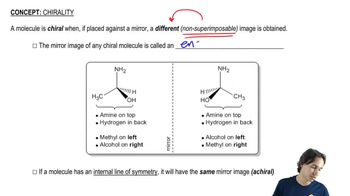
Chirality is a property of a molecule that makes it non-superimposable on its mirror image, much like left and right hands. A chiral molecule typically has one or more chiral centers, often carbon atoms bonded to four different substituents. The presence of chirality in the reaction products means that the two stereoisomers can have distinct biological activities, which is particularly relevant in pharmaceuticals like eclanamine.
Dimethylamine is a nucleophile that can react with epoxides, such as cyclopentene oxide, through a ring-opening mechanism. This reaction typically involves the nucleophile attacking the less hindered carbon of the epoxide, leading to the formation of an amine product. The stereochemistry of the resulting amine can vary depending on the attack's orientation, resulting in different stereoisomers, including the R,R-isomer and its counterpart.