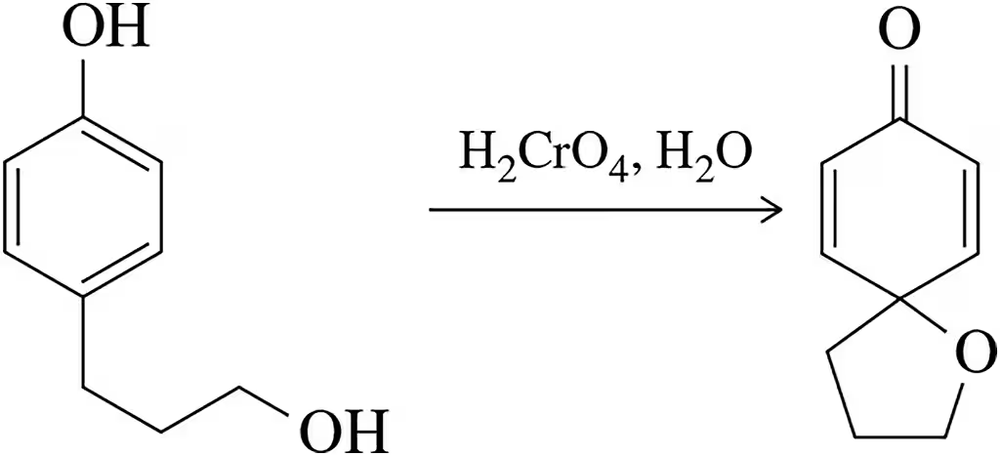
A chemist attempted to oxidize a primary alcohol to a carboxylic acid using chromic acid. The product shown was obtained as a major component in the mixture. Suggest an arrow-pushing mechanism that accounts for its formation. [Think about what chromic acid would normally do to a phenol and make a list of bonds formed and bonds broken.]
Verified step by step guidance
1
Identify the starting material: The primary alcohol is the substrate that will undergo oxidation. Chromic acid is a strong oxidizing agent typically used to convert primary alcohols to carboxylic acids.
Consider the role of chromic acid: Chromic acid (H₂CrO₄) is known to oxidize alcohols by first converting them to aldehydes, which can further oxidize to carboxylic acids. However, in the presence of phenolic groups, chromic acid can lead to different pathways.
Analyze the reaction conditions: In the presence of phenolic groups, chromic acid can lead to the formation of quinones or other oxidized products. Consider how the phenolic group might interact with chromic acid, potentially leading to a different major product.
List bonds formed and broken: During the oxidation process, the C-H bond of the alcohol is broken, and a C=O bond is formed. If a phenolic group is involved, additional C-O bonds may form, and aromatic C=C bonds may rearrange.
Propose an arrow-pushing mechanism: Begin with the alcohol oxygen attacking the chromium center, forming a chromate ester. This intermediate can undergo a series of electron transfers, leading to the formation of a carbonyl group and potentially rearranging the aromatic system if phenolic groups are involved.
Verified video answer for a similar problem:
This video solution was recommended by our tutors as helpful for the problem above
Play a video:
Was this helpful?
Key Concepts
Here are the essential concepts you must grasp in order to answer the question correctly.
Oxidation of Alcohols
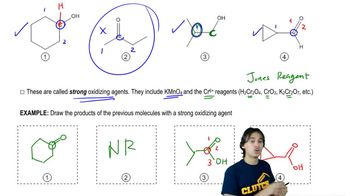
Oxidation of alcohols involves the conversion of primary alcohols to aldehydes and further to carboxylic acids using oxidizing agents like chromic acid. Chromic acid is a strong oxidizing agent that facilitates the removal of hydrogen atoms from the alcohol, forming a carbonyl group. Understanding this process is crucial for predicting the outcome of the reaction.
Arrow-pushing is a technique used to illustrate the movement of electrons during chemical reactions. It involves drawing arrows to show how electron pairs move from nucleophiles to electrophiles, forming and breaking bonds. This concept helps in visualizing the step-by-step transformation of reactants to products, essential for understanding complex organic reactions.
Phenols react differently with chromic acid compared to alcohols due to the stability of the aromatic ring. Chromic acid can oxidize phenols to quinones, involving the formation of new carbon-oxygen bonds and the breaking of carbon-hydrogen bonds. Recognizing this reactivity is key to predicting the products formed when phenols are subjected to oxidation.