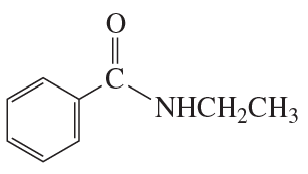
How could you synthesize the following compounds starting with a carboxylic acid? b.
Verified step by step guidance
1
Step 1: Begin with a carboxylic acid that has the aromatic ring structure with a nitro group (-NO2) in the para position. This will serve as the starting material for the synthesis.
Step 2: Convert the carboxylic acid group (-COOH) into an acid chloride (-COCl) using a reagent such as thionyl chloride (SOCl2). This step activates the carboxylic acid for further reactions.
Step 3: Perform an amide formation reaction by reacting the acid chloride with cyclopentylamine (C5H9NH2). This will result in the formation of the desired amide bond (-CONH-). Use a base like pyridine to neutralize the HCl byproduct.
Step 4: Ensure the reaction conditions are mild to avoid any side reactions, such as reduction of the nitro group (-NO2) or overreaction of the amine.
Step 5: Purify the final product using techniques such as recrystallization or column chromatography to isolate the desired compound with the nitro group intact and the amide bond formed.
Verified video answer for a similar problem:
This video solution was recommended by our tutors as helpful for the problem above
Video duration:
7m
Play a video:
Was this helpful?
Key Concepts
Here are the essential concepts you must grasp in order to answer the question correctly.
Carboxylic Acids
Carboxylic acids are organic compounds characterized by the presence of a carboxyl group (-COOH). They are important in organic synthesis as they can be converted into various derivatives, such as acid chlorides, esters, and amides. Understanding their reactivity and functional group transformations is crucial for synthesizing more complex molecules.
Acid chlorides, also known as acyl chlorides, are derived from carboxylic acids by replacing the hydroxyl group (-OH) with a chlorine atom. They are highly reactive intermediates in organic synthesis, often used to form esters and amides. Their ability to react with nucleophiles makes them valuable in constructing various organic compounds.
Nucleophilic acyl substitution is a fundamental reaction mechanism in organic chemistry where a nucleophile attacks the carbonyl carbon of an acyl compound, leading to the substitution of a leaving group. This mechanism is key in the transformation of acid chlorides into other functional groups, such as amides or esters, and is essential for understanding the synthesis of complex organic molecules.