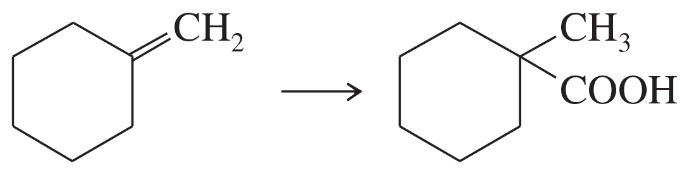
Show how you would accomplish the following multistep syntheses. You may use any additional reagents and solvents you need. (b)
Verified step by step guidance
1
Step 1: Analyze the starting material and the product. The starting material is a cyclohexene derivative with a double bond, and the product is a cyclohexane derivative with a carboxylic acid group (-COOH) attached. This suggests that the double bond needs to be oxidized and functionalized to introduce the carboxylic acid group.
Step 2: Perform an oxidative cleavage of the double bond using a reagent such as ozone (O₃) followed by a reductive workup with dimethyl sulfide (DMS) or zinc (Zn). This will cleave the double bond and yield two carbonyl groups (aldehydes or ketones) depending on the substitution pattern.
Step 3: Convert the aldehyde group formed from the oxidative cleavage into a carboxylic acid group. This can be achieved using an oxidizing agent such as potassium permanganate (KMnO₄) or chromium-based reagents like Jones reagent (CrO₃/H₂SO₄).
Step 4: Ensure that the reaction conditions are mild enough to avoid overoxidation or degradation of the cyclohexane ring. Use appropriate solvents and temperatures to maintain the integrity of the molecule.
Step 5: Purify the product using techniques such as recrystallization or chromatography to isolate the desired cyclohexane derivative with the carboxylic acid group.
Verified video answer for a similar problem:
This video solution was recommended by our tutors as helpful for the problem above
Video duration:
7m
Play a video:
0 Comments
Key Concepts
Here are the essential concepts you must grasp in order to answer the question correctly.
Carboxylation
Carboxylation is a chemical reaction that introduces a carboxyl group (-COOH) into an organic compound. This process often involves the addition of carbon dioxide (CO2) to a substrate, typically in the presence of a catalyst or specific reagents. In the context of the provided reaction, carboxylation transforms a cyclohexene derivative into a carboxylic acid, showcasing the utility of this reaction in organic synthesis.
Cycloalkenes are cyclic hydrocarbons that contain at least one carbon-carbon double bond. Their unique structure allows for various chemical reactions, including electrophilic additions and rearrangements. Understanding the reactivity of cycloalkenes is crucial for predicting the outcomes of reactions, such as the carboxylation depicted in the question, where the double bond plays a key role in the reaction mechanism.
A reaction mechanism is a step-by-step description of the process by which reactants are converted into products. It outlines the sequence of bond-breaking and bond-forming events, providing insight into how and why a reaction occurs. For the carboxylation of the cyclohexene derivative, understanding the mechanism helps in identifying the necessary reagents and conditions to achieve the desired carboxylic acid product.