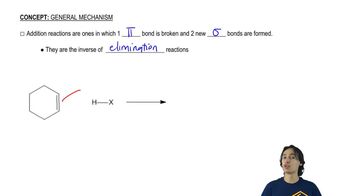
What stereoisomers are obtained when 2-butyne undergoes each of the following reaction sequences? c. 1. Cl2/CH2Cl2 2. Br2/CH2Cl2
Verified step by step guidance
1
Step 1: Understand the starting material and the reaction conditions. The starting material is 2-butyne, which is an alkyne with a triple bond between the second and third carbons. The reaction involves two halogenation steps: first with Cl2 in CH2Cl2, and then with Br2 in CH2Cl2.
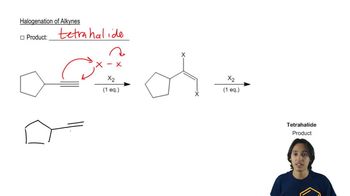
Step 2: Analyze the first reaction (Cl2/CH2Cl2). When 2-butyne reacts with Cl2 in an inert solvent like CH2Cl2, the triple bond undergoes electrophilic addition. The first equivalent of Cl2 adds across the triple bond, forming a trans-dichloroalkene as the major product due to anti-addition.
Step 3: Consider the second reaction (Br2/CH2Cl2). The trans-dichloroalkene formed in the first step reacts with Br2 in CH2Cl2. This reaction is also an electrophilic addition, where Br2 adds across the double bond. The addition occurs in an anti-fashion, leading to the formation of a tetrahalogenated product.
Step 4: Determine the stereochemistry of the final product. Since both halogenation steps proceed via anti-addition, the final product will have specific stereochemistry. The relative positions of the chlorine and bromine atoms on the carbon chain will depend on the anti-addition mechanism.
Step 5: Summarize the stereoisomers. The final product will be a tetrahalogenated compound with two chlorines and two bromines. The stereoisomers will depend on the anti-addition in both steps, leading to a specific arrangement of the halogen atoms on the carbon chain.
Verified video answer for a similar problem:
This video solution was recommended by our tutors as helpful for the problem above
Video duration:
2m
Play a video:
Was this helpful?
Key Concepts
Here are the essential concepts you must grasp in order to answer the question correctly.
Stereoisomerism
Stereoisomerism refers to the phenomenon where compounds have the same molecular formula and connectivity of atoms but differ in the spatial arrangement of those atoms. This can lead to different physical and chemical properties. In the case of alkenes and alkynes, stereoisomers can include cis-trans isomers and enantiomers, which are crucial for understanding the outcomes of reactions involving these compounds.
Electrophilic addition reactions are a type of reaction where an electrophile reacts with a nucleophile, resulting in the addition of atoms or groups across a double or triple bond. In the context of 2-butyne reacting with Cl2 and Br2, these reactions lead to the formation of vicinal dihalides, which can exhibit stereoisomerism depending on the orientation of the added halogen atoms.
Halogenation of alkynes involves the addition of halogen molecules (like Cl2 or Br2) to the carbon-carbon triple bond, resulting in the formation of alkenes or alkanes with halogen substituents. The stereochemistry of the resulting products can vary based on the reaction conditions and the order of halogen addition, leading to different stereoisomers, which is essential for predicting the outcomes of the given reaction sequence.