Textbook Question
Draw the products of each of the following SN2/E2 reactions. If the products can exist as stereoisomers, show which stereoisomers are formed.
c. (3S,4R)-3-bromo-4-methylhexane + CH3O−
1179
views

 Bruice 8th EditionCh. 9 - Substitution and Elimination Reactions of Alkyl HalidesProblem 117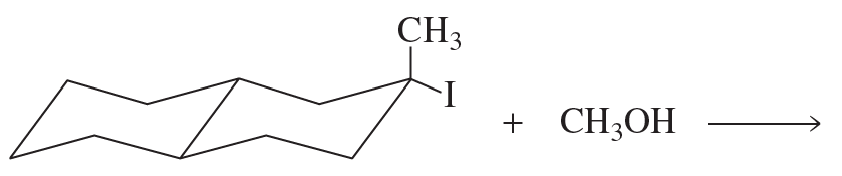
 Verified step by step guidance
 01:47
01:47
 05:58
05:58 03:32
03:32Draw the products of each of the following SN2/E2 reactions. If the products can exist as stereoisomers, show which stereoisomers are formed.
c. (3S,4R)-3-bromo-4-methylhexane + CH3O−
How could you prepare the following compounds from the given starting materials?
b.
cis-4-Bromocyclohexanol and trans-4-bromocyclohexanol form the same elimination product but a different substitution product when they react with HO−.
a. Why do they form the same elimination product?
cis-4-Bromocyclohexanol and trans-4-bromocyclohexanol form the same elimination product but a different substitution product when they react with HO−.
b. Explain, by showing the mechanisms, why different substitution products are obtained.
Two elimination products are obtained from the following E2 reaction:
a. What are the elimination products?
b. Which is formed in greater yield?
Draw the products of each of the following SN2/E2 reactions. If the products can exist as stereoisomers, show which stereoisomers are formed.
b. (3R,4R)-3-bromo-4-methylhexane + CH3O−