The two most general amine syntheses are the reductive amination of carbonyl compounds and the reduction of amides. Show how these techniques can be used to accomplish the following syntheses. (b) benzaldehyde → benzylamine
Verified step by step guidance
1
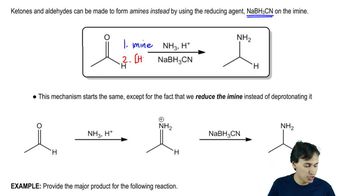
Identify the starting material (benzaldehyde) and the target product (benzylamine). Benzaldehyde is an aromatic aldehyde, and benzylamine is a primary amine. This suggests that reductive amination is a suitable method for this transformation.
In reductive amination, the carbonyl group of the aldehyde reacts with an amine to form an imine intermediate. In this case, ammonia (NH₃) will be used as the amine source to form the imine.
Write the reaction for the formation of the imine: Benzaldehyde reacts with ammonia (NH₃) under acidic or neutral conditions to form an imine (C₆H₅CH=NH). This step involves nucleophilic attack of ammonia on the carbonyl carbon, followed by dehydration to form the imine.
The imine intermediate is then reduced to the corresponding amine (benzylamine) using a reducing agent. Common reducing agents for this step include sodium cyanoborohydride (NaBH₃CN) or hydrogen gas (H₂) with a metal catalyst like palladium (Pd) or nickel (Ni).
Combine the steps into the overall reaction: Benzaldehyde reacts with ammonia to form an imine intermediate, which is subsequently reduced to benzylamine using a suitable reducing agent. This completes the synthesis of benzylamine from benzaldehyde via reductive amination.
Verified video answer for a similar problem:
This video solution was recommended by our tutors as helpful for the problem above
Video duration:
6m
Play a video:
Was this helpful?
Key Concepts
Here are the essential concepts you must grasp in order to answer the question correctly.
Reductive Amination
Reductive amination is a two-step process involving the reaction of a carbonyl compound, such as an aldehyde or ketone, with an amine to form an imine or enamine, followed by reduction to yield an amine. In the case of benzaldehyde, it reacts with ammonia or an amine to form an intermediate imine, which is then reduced to benzylamine using a reducing agent like sodium cyanoborohydride.
The reduction of amides involves converting an amide functional group into an amine by adding hydrogen or a reducing agent. This process typically requires stronger reducing agents, such as lithium aluminum hydride (LiAlH4), which can effectively reduce the carbonyl carbon of the amide to yield the corresponding amine. While this method is not directly applicable to the synthesis of benzylamine from benzaldehyde, it is a fundamental concept in amine synthesis.
Understanding the mechanism of carbonyl reactions is crucial for predicting the outcomes of reactions involving carbonyl compounds. In the case of benzaldehyde, the nucleophilic attack by the amine on the electrophilic carbon of the carbonyl group leads to the formation of a tetrahedral intermediate, which can then collapse to form the imine. This mechanistic insight is essential for grasping how reductive amination can be employed to synthesize benzylamine.