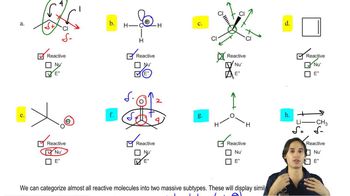
Within each set of structures, indicate which will react fastest, and which slowest, toward nucleophilic addition in basic conditions. (c)
Verified step by step guidance
1
Analyze the structures provided: All three molecules are ketones, with varying substituents attached to the carbonyl carbon. The substituents are either fluorinated groups (CF3 or F3C) or methyl groups (CH3).
Understand the concept: Nucleophilic addition to a carbonyl group in basic conditions depends on the electrophilicity of the carbonyl carbon. Electrophilicity is influenced by the electron-withdrawing or electron-donating nature of the substituents attached to the carbonyl carbon.
Evaluate the substituents: Fluorine atoms are highly electronegative and act as strong electron-withdrawing groups. Substituents like CF3 or F3C increase the electrophilicity of the carbonyl carbon, making it more reactive toward nucleophilic attack. Methyl groups (CH3), on the other hand, are electron-donating and reduce the electrophilicity of the carbonyl carbon.
Rank the reactivity: The molecule with two CF3 groups (F3C-C=O-CF3) will react fastest because it has the most electron-withdrawing substituents, making the carbonyl carbon highly electrophilic. The molecule with one CF3 group and one CH3 group (H3C-C=O-CF3) will react slower than the first but faster than the molecule with two CH3 groups (H3C-C=O-CH3), which will react slowest due to the electron-donating nature of the methyl groups.
Conclude: The reactivity order toward nucleophilic addition in basic conditions is: F3C-C=O-CF3 (fastest) > H3C-C=O-CF3 > H3C-C=O-CH3 (slowest).
Verified video answer for a similar problem:
This video solution was recommended by our tutors as helpful for the problem above
Video duration:
3m
Play a video:
Was this helpful?
Key Concepts
Here are the essential concepts you must grasp in order to answer the question correctly.
Nucleophilic Addition
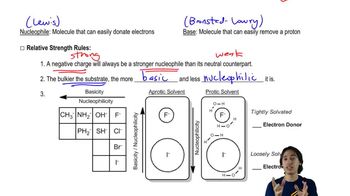
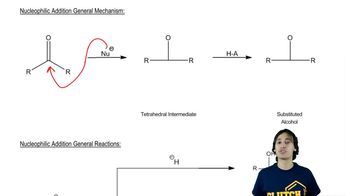
Nucleophilic addition is a fundamental reaction in organic chemistry where a nucleophile attacks an electrophilic carbon atom, typically in carbonyl compounds. This reaction is crucial for forming new carbon-carbon or carbon-heteroatom bonds. The rate of nucleophilic addition can be influenced by the electrophilicity of the carbonyl carbon and the strength of the nucleophile.
Electrophilicity refers to the tendency of a chemical species to accept electrons, making it a target for nucleophiles. In the context of carbonyl compounds, the carbon atom is electrophilic due to the partial positive charge created by the polarization of the carbon-oxygen double bond. Factors such as steric hindrance and the presence of electron-withdrawing groups can enhance or diminish electrophilicity, affecting reaction rates.
Basic conditions in organic chemistry typically involve the presence of a base that can deprotonate acidic protons, thereby increasing the nucleophilicity of certain species. In nucleophilic addition reactions, basic conditions can facilitate the formation of stronger nucleophiles, such as alkoxides, which can enhance the reaction rate. Understanding how pH and the nature of the base influence the reaction environment is essential for predicting reaction outcomes.