How many stereoisomers are possible for a. a ketoheptose?
Verified step by step guidance
1
Understand the structure of a ketoheptose: A ketoheptose is a seven-carbon sugar (heptose) with a ketone functional group. The ketone group is typically located at the second carbon (C-2), making it a 2-ketoheptose.
Determine the number of chiral centers: In a ketoheptose, the ketone group at C-2 is not a chiral center. The remaining five carbons (C-3 to C-7) each have a hydroxyl (-OH) group and a hydrogen (-H) attached, making them potential chiral centers. Therefore, there are 5 chiral centers in a ketoheptose.
Apply the formula for the number of stereoisomers: The number of stereoisomers for a molecule with 'n' chiral centers is given by the formula \( 2^n \). For a ketoheptose with 5 chiral centers, substitute \( n = 5 \) into the formula.
Calculate \( 2^5 \): This step involves determining the total number of stereoisomers by evaluating \( 2^5 \), which represents the possible combinations of configurations (R or S) at each chiral center.
Conclude the total number of stereoisomers: The result from the previous step gives the total number of stereoisomers possible for a ketoheptose, including both enantiomers and diastereomers.
Verified video answer for a similar problem:
This video solution was recommended by our tutors as helpful for the problem above
Video duration:
2m
Play a video:
Was this helpful?
Key Concepts
Here are the essential concepts you must grasp in order to answer the question correctly.
Stereoisomerism
Stereoisomerism refers to the phenomenon where compounds have the same molecular formula and connectivity of atoms but differ in the spatial arrangement of their atoms. This can lead to different physical and chemical properties. In carbohydrates, stereoisomers arise due to the presence of chiral centers, which are carbon atoms bonded to four different groups.
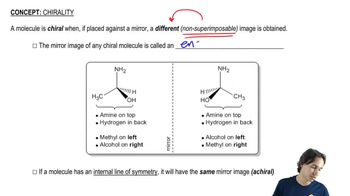
Chirality is a property of a molecule that makes it non-superimposable on its mirror image, much like left and right hands. A chiral center, typically a carbon atom, is bonded to four distinct substituents, leading to two possible configurations (enantiomers). The number of chiral centers in a molecule directly influences the number of stereoisomers it can have.
The total number of stereoisomers for a compound can be calculated using the formula 2^n, where n is the number of chiral centers. For a ketoheptose, which has multiple chiral centers, this formula helps determine the maximum number of stereoisomers possible. Additionally, the presence of any symmetry in the molecule can reduce the total count of unique stereoisomers.