Draw a condensed structure and a skeletal structure for each of the following: k. 3,4-dimethyloctane
Verified step by step guidance
1
Step 1: Understand the name of the compound. The name '3,4-dimethyloctane' indicates that the parent chain is 'octane,' which consists of 8 carbon atoms in a straight chain. The '3,4-dimethyl' prefix means there are methyl groups (-CH₃) attached to the 3rd and 4th carbons of the octane chain.
Step 2: Draw the parent chain (octane) as a straight chain of 8 carbon atoms. Ensure that each carbon is connected by single bonds, as 'octane' is an alkane (saturated hydrocarbon).
Step 3: Identify the 3rd and 4th carbons in the chain. Starting from one end of the chain, number the carbons sequentially from 1 to 8. The 3rd and 4th carbons are where the methyl groups will be attached.
Step 4: Attach a methyl group (-CH₃) to the 3rd and 4th carbons of the chain. This modifies the structure to include the substituents specified in the name.
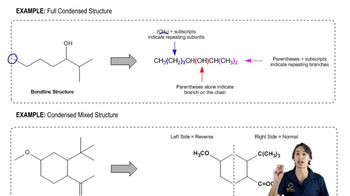
Step 5: Draw both the condensed structure and the skeletal structure. For the condensed structure, write the formula in a compact form, showing all atoms explicitly (e.g., CH₃ groups and CH₂ groups). For the skeletal structure, represent the carbon chain as a zigzag line, omitting hydrogen atoms, and show the methyl groups as branches at the appropriate positions.
Verified video answer for a similar problem:
This video solution was recommended by our tutors as helpful for the problem above
Video duration:
9m
Play a video:
Was this helpful?
Key Concepts
Here are the essential concepts you must grasp in order to answer the question correctly.
Condensed Structure
A condensed structure is a simplified representation of a molecule that shows the arrangement of atoms and the connectivity between them without depicting all the bonds explicitly. In this format, groups of atoms are often grouped together, and hydrogen atoms attached to carbons are usually omitted for clarity. For example, 3,4-dimethyloctane can be represented as CH3(CH(CH3)CH2)2CH(CH3)CH2CH3, indicating the branching at the 3rd and 4th carbon atoms.
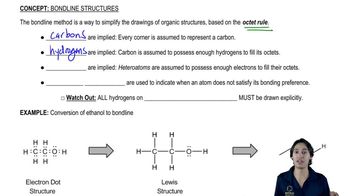
A skeletal structure, also known as a line-angle structure, is a way of drawing organic molecules that emphasizes the carbon backbone. In this representation, carbon atoms are represented by the ends and intersections of lines, while hydrogen atoms are typically omitted. For 3,4-dimethyloctane, the skeletal structure would show a zigzag line with branches at the appropriate positions, making it easier to visualize the molecular framework.
Isomerism refers to the phenomenon where compounds have the same molecular formula but different structural arrangements or spatial orientations. In the case of 3,4-dimethyloctane, understanding isomerism is crucial as it can exist in various forms depending on the arrangement of the methyl groups on the octane chain. This concept is essential for accurately drawing both condensed and skeletal structures, as it influences the overall shape and properties of the molecule.