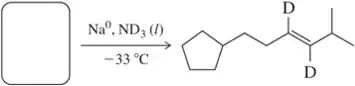
Suggest alkynes that might be used to make the following trans-alkenes. (c)
Verified step by step guidance
1
Identify the trans-alkene product structure. A trans-alkene has two substituents on opposite sides of the double bond. Analyze the given trans-alkene to determine the carbon chain and substituents.
Recall that alkynes can be reduced to trans-alkenes using a dissolving metal reduction, such as sodium (Na) in liquid ammonia (NH₃). This reaction selectively produces trans-alkenes from alkynes.
Determine the alkyne precursor by adding a triple bond in place of the double bond in the trans-alkene. This involves identifying the two carbons involved in the double bond and converting it into a triple bond.
Ensure that the alkyne precursor has the correct number of carbons and substituents to match the trans-alkene product after reduction. Verify that the structure of the alkyne aligns with the desired trans-alkene.
Propose the alkyne(s) that could be used as starting materials. For example, if the trans-alkene has substituents on opposite sides, the corresponding alkyne should have the same substituents attached to the triple bond carbons.
Verified video answer for a similar problem:
This video solution was recommended by our tutors as helpful for the problem above
Video duration:
3m
Play a video:
Was this helpful?
Key Concepts
Here are the essential concepts you must grasp in order to answer the question correctly.
Alkynes
Alkynes are hydrocarbons that contain at least one carbon-carbon triple bond. They are unsaturated compounds and are represented by the general formula CnH2n-2. Alkynes can undergo various reactions, including addition reactions, which are crucial for synthesizing other organic compounds, such as alkenes and alcohols.
Trans-alkenes are a type of alkene where the substituents on either side of the double bond are positioned on opposite sides, leading to a more stable configuration due to reduced steric strain. The geometric isomerism in alkenes is significant in organic chemistry, as it affects the physical and chemical properties of the compounds.
Elimination reactions involve the removal of atoms or groups from a molecule, resulting in the formation of a double or triple bond. In the context of synthesizing trans-alkenes from alkynes, a common method is the partial hydrogenation of alkynes or the elimination of a leaving group from a precursor compound, which can yield the desired trans configuration.