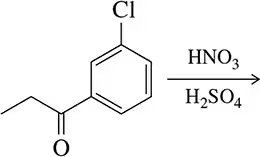
Predict the major product of the following electrophilic aromatic substitution reactions. (c)
Verified step by step guidance
1
Identify the type of reaction: The reaction shown is an electrophilic aromatic substitution (EAS), where a nitro group (NO2) will be introduced to the aromatic ring.
Determine the directing effects of substituents: The benzene ring has a chlorine (Cl) substituent, which is an ortho/para-directing group due to its electron-withdrawing nature through resonance, and a carbonyl group (C=O) which is a meta-directing group due to its electron-withdrawing nature through induction.
Consider the reaction conditions: The presence of HNO3 and H2SO4 indicates a nitration reaction, where the nitronium ion (NO2+) is the electrophile.
Predict the major product: Given the presence of both ortho/para and meta-directing groups, the position of the nitro group will be influenced by the stronger directing effect. The chlorine group, being ortho/para-directing, will favor substitution at the ortho or para position relative to itself.
Select the most likely position: The para position relative to the chlorine is less sterically hindered compared to the ortho position, making it the most favorable site for nitration. Therefore, the major product will have the nitro group at the para position relative to the chlorine substituent.
Verified video answer for a similar problem:
This video solution was recommended by our tutors as helpful for the problem above
Play a video:
Was this helpful?
Key Concepts
Here are the essential concepts you must grasp in order to answer the question correctly.
Electrophilic Aromatic Substitution (EAS)
Electrophilic Aromatic Substitution is a reaction where an aromatic ring, such as benzene, undergoes substitution of a hydrogen atom by an electrophile. This process involves the formation of a highly reactive intermediate called an arenium ion, which is stabilized by resonance. The reaction typically requires a strong acid to generate the electrophile, as seen with the use of HNO3 and H2SO4 to produce the nitronium ion (NO2+).
Substituents on an aromatic ring influence the position where new groups are added during EAS. Electron-donating groups (EDGs) generally direct new substituents to the ortho and para positions, while electron-withdrawing groups (EWGs) direct them to the meta position. In the given structure, the chlorine atom is an ortho/para director due to its lone pairs, while the carbonyl group is a meta director due to its electron-withdrawing nature.
Directing Effects in Substituted Pyrroles, Furans, and Thiophenes Concept 1
Reactivity and Orientation in EAS
The reactivity and orientation in EAS are influenced by the nature of substituents on the aromatic ring. In the given molecule, the presence of both a chlorine atom and a carbonyl group creates competing directing effects. Chlorine, being a weak electron-donating group, directs ortho/para, while the carbonyl group, a strong electron-withdrawing group, directs meta. The major product is often determined by the stronger directing influence, which in this case is the meta-directing carbonyl group.