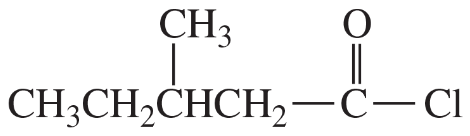
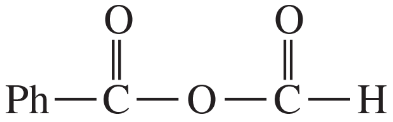
Give appropriate names for the following compounds: (a) (b)
Verified step by step guidance
1
Step 1: Analyze the first compound. The structure contains a chlorine atom attached to a carbonyl group (C=O), which indicates it is an acyl chloride. The longest carbon chain includes 5 carbons, with a methyl group as a substituent on the second carbon. Identify the parent chain and substituents.
Step 2: Name the parent chain for the first compound. The longest chain has 5 carbons, so the base name is 'pentanoyl chloride'. Incorporate the substituent (methyl group) at the correct position (carbon 2). Use IUPAC rules to name the compound.
Step 3: Analyze the second compound. The structure contains two carbonyl groups (C=O) separated by an oxygen atom, which indicates it is an ester. One side of the ester is a phenyl group (Ph), and the other side is a formyl group (H-C=O). Identify the functional groups and substituents.
Step 4: Name the parent chain for the second compound. The phenyl group is attached to the ester oxygen, and the formyl group is part of the acyl chain. The base name for the ester is 'benzyl formate'. Use IUPAC rules to name the compound.
Step 5: Combine the substituents and parent chain names for both compounds, ensuring proper placement of locants and functional group priorities. Verify the names follow IUPAC conventions for clarity and accuracy.
Verified video answer for a similar problem:
This video solution was recommended by our tutors as helpful for the problem above
Video duration:
5m
Play a video:
Was this helpful?
Key Concepts
Here are the essential concepts you must grasp in order to answer the question correctly.
Nomenclature of Organic Compounds
Nomenclature is the systematic naming of chemical compounds based on established rules. In organic chemistry, the IUPAC (International Union of Pure and Applied Chemistry) system is commonly used, which involves identifying the longest carbon chain, determining functional groups, and applying prefixes and suffixes to create a unique name for each compound.
Functional groups are specific groups of atoms within molecules that are responsible for the characteristic chemical reactions of those molecules. In the context of the given compounds, recognizing functional groups such as anhydrides, halides, and carbonyls is essential for accurate naming and understanding their reactivity and properties.
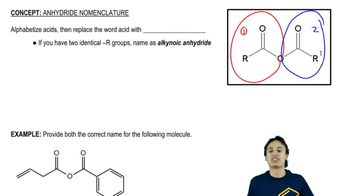
Anhydrides are a class of compounds derived from acids by the removal of water. They typically contain two acyl groups bonded to the same oxygen atom. Understanding the structure and naming conventions for anhydrides is crucial for identifying the compounds in the question, as they influence the overall naming process and the compound's chemical behavior.