Suggest a synthesis of the following aldehydes or ketones using the ozonolysis reaction of an alkene. (b)
Verified step by step guidance
1
Identify the products of the ozonolysis reaction: acetophenone (C₆H₅C(O)CH₃) and formaldehyde (HCHO).
Recognize that ozonolysis cleaves the double bond of an alkene to form carbonyl compounds. The products suggest the original alkene had a structure that splits into these two fragments.
Determine the structure of the alkene that would yield acetophenone and formaldehyde upon ozonolysis. The alkene must have a double bond between the carbon atoms that will form the carbonyl groups in the products.
Consider the connectivity of the alkene: the carbon atom that forms acetophenone must be connected to the phenyl group and a methyl group, while the carbon atom that forms formaldehyde must be connected to a hydrogen atom.
Propose the structure of the alkene: phenylpropene (C₆H₅CH=CH₂), where the double bond is between the terminal carbon and the adjacent carbon, allowing for the formation of acetophenone and formaldehyde upon ozonolysis.
Verified video answer for a similar problem:
This video solution was recommended by our tutors as helpful for the problem above
Play a video:
Was this helpful?
Key Concepts
Here are the essential concepts you must grasp in order to answer the question correctly.
Ozonolysis Reaction
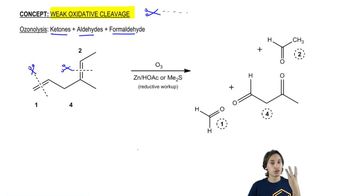
Ozonolysis is a reaction where ozone (O3) cleaves alkenes to form carbonyl compounds, such as aldehydes and ketones. The reaction involves the formation of an ozonide intermediate, which is then reduced to yield the final products. This process is useful for determining the position of double bonds in alkenes and synthesizing specific carbonyl compounds.
The structure of the alkene is crucial in ozonolysis as it determines the resulting carbonyl compounds. In the given image, the alkene must have a double bond positioned such that upon cleavage, it forms the specified ketone and aldehyde. Understanding the connectivity and substitution pattern of the alkene helps predict the ozonolysis products accurately.
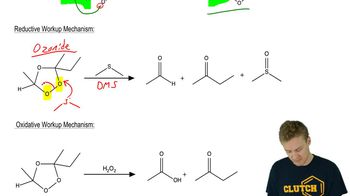
Reductive workup in ozonolysis involves using a reducing agent, such as dimethyl sulfide (CH3SCH3), to convert the ozonide intermediate into stable carbonyl compounds. This step is essential to prevent the formation of unwanted by-products and ensure the desired aldehydes and ketones are obtained. The choice of reducing agent can influence the yield and purity of the final products.