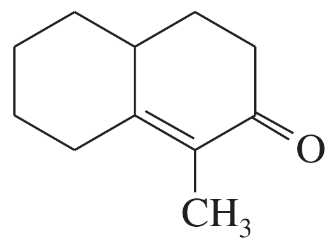
Show how you would use Robinson annulations to synthesize the following compounds. Work backward, remembering that the cyclohexenone is the new ring and that the double bond of the cyclohexenone is formed by the aldol with dehydration. Take apart the double bond, then see what structures the Michael donor and acceptor must have. (a)
Verified step by step guidance
1
Step 1: Analyze the target molecule. The compound contains a cyclohexenone ring with a methyl group at the β-position relative to the carbonyl group. This suggests that the Robinson annulation was used to form the cyclohexenone ring.
Step 2: Work backward by breaking the double bond in the cyclohexenone ring. The double bond is formed during the aldol condensation step with dehydration. Identify the precursor structures that would undergo aldol condensation.
Step 3: Determine the Michael donor and acceptor. The Michael donor is typically an enolate, and the Michael acceptor is an α,β-unsaturated carbonyl compound. In this case, the methyl group at the β-position suggests that the Michael donor was a methyl ketone.
Step 4: Propose the starting materials. The Michael donor is acetone (CH3COCH3), and the Michael acceptor is methyl vinyl ketone (CH2=CHCOCH3). These two compounds undergo a Michael addition followed by an aldol condensation to form the cyclohexenone ring.
Step 5: Outline the reaction sequence. First, the enolate of acetone attacks the β-carbon of methyl vinyl ketone in a Michael addition. This intermediate then undergoes an intramolecular aldol condensation, followed by dehydration, to form the cyclohexenone ring with the methyl group at the β-position.
Verified video answer for a similar problem:
This video solution was recommended by our tutors as helpful for the problem above
Video duration:
1m
Play a video:
Was this helpful?
Key Concepts
Here are the essential concepts you must grasp in order to answer the question correctly.
Robinson Annulation
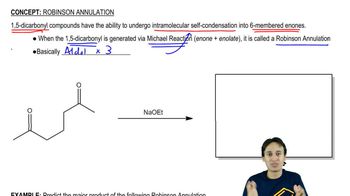
The Robinson annulation is a key reaction in organic synthesis that combines a Michael addition and an aldol condensation to form cyclic compounds. It typically involves the reaction of a ketone or aldehyde with a Michael donor, followed by dehydration to create a double bond. This method is particularly useful for constructing complex ring structures, such as cyclohexenones, which are often found in natural products.
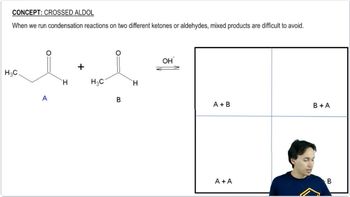
Aldol condensation is a fundamental reaction in organic chemistry where aldehydes or ketones react in the presence of a base to form β-hydroxy carbonyl compounds. This reaction involves the formation of an enolate ion, which then attacks another carbonyl compound. The resulting β-hydroxy carbonyl can undergo dehydration to yield an α,β-unsaturated carbonyl compound, which is crucial in the formation of double bonds in cyclic structures.
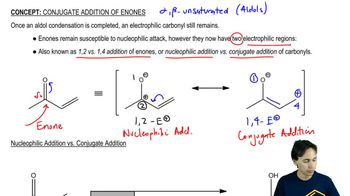
The Michael addition is a nucleophilic addition reaction where a nucleophile adds to an α,β-unsaturated carbonyl compound. In this reaction, the nucleophile typically attacks the β-carbon, leading to the formation of a new carbon-carbon bond. This step is essential in the Robinson annulation process, as it sets the stage for the subsequent aldol condensation and the formation of the desired cyclic structure.