The Principle of Microscopic Reversibility states that a forward reaction and a reverse reaction taking place under the same conditions (as in an equilibrium) must follow the same reaction pathway in microscopic detail. The reverse of the Fischer esterification is the acid-catalyzed hydrolysis of an ester. Propose a mechanism for the acid-catalyzed hydrolysis of ethyl benzoate, PhCOOCH2CH3.
Verified step by step guidance
1
Step 1: Protonation of the ester carbonyl group: The acid catalyst donates a proton (H⁺) to the carbonyl oxygen of ethyl benzoate (PhCOOCH₂CH₃), increasing the electrophilicity of the carbonyl carbon. This step forms a protonated intermediate.
Step 2: Nucleophilic attack by water: A water molecule acts as a nucleophile and attacks the electrophilic carbonyl carbon of the protonated ester. This results in the formation of a tetrahedral intermediate.
Step 3: Proton transfer: A proton is transferred within the tetrahedral intermediate to stabilize the structure. This step prepares the intermediate for the next step by converting the leaving group into a better leaving group.
Step 4: Elimination of ethanol: The tetrahedral intermediate collapses, expelling ethanol (CH₃CH₂OH) as a leaving group. This step regenerates the carbonyl group and forms a protonated benzoic acid intermediate.
Step 5: Deprotonation to form the product: The protonated benzoic acid intermediate loses a proton (H⁺) to regenerate the acid catalyst and form the final product, benzoic acid (PhCOOH).
Verified video answer for a similar problem:
This video solution was recommended by our tutors as helpful for the problem above
Video duration:
6m
Play a video:
Was this helpful?
Key Concepts
Here are the essential concepts you must grasp in order to answer the question correctly.
Fischer Esterification
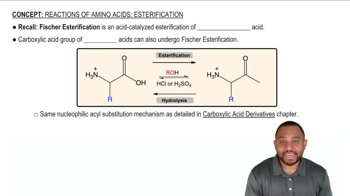
Fischer esterification is a chemical reaction that forms an ester from a carboxylic acid and an alcohol in the presence of an acid catalyst. This process involves the nucleophilic attack of the alcohol on the carbonyl carbon of the carboxylic acid, leading to the formation of an ester and water. Understanding this mechanism is crucial as it provides the reverse reaction pathway for hydrolysis.
Reactions of Amino Acids: Esterification Concept 1
Microscopic Reversibility
The Principle of Microscopic Reversibility states that the detailed steps of a forward reaction are mirrored in the reverse reaction under the same conditions. This principle implies that the transition states and intermediates involved in the forward reaction will also be present in the reverse reaction, allowing for a deeper understanding of reaction mechanisms and equilibrium.
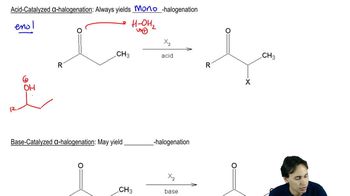
Acid-catalyzed hydrolysis is a reaction where an ester reacts with water in the presence of an acid catalyst to produce a carboxylic acid and an alcohol. This process involves protonation of the carbonyl oxygen, making the carbonyl carbon more electrophilic, followed by nucleophilic attack by water. Recognizing this mechanism is essential for proposing the hydrolysis pathway of esters like ethyl benzoate.