Show how you would use the Friedel–Crafts acylation, Clemmensen reduction, and/or Gatterman–Koch synthesis to prepare the following compounds: e. 3-methyl-1-phenylbutane
Verified step by step guidance
1
Step 1: Begin by analyzing the target molecule, 3-methyl-1-phenylbutane. It consists of a benzene ring attached to a butane chain with a methyl group at the 3-position. This suggests that the synthesis will involve introducing a butane chain onto the benzene ring, followed by modifications to achieve the correct branching.
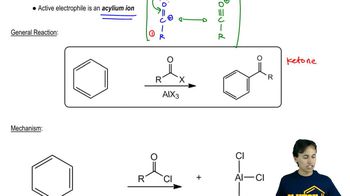
Step 2: Use Friedel–Crafts acylation to introduce a butanoyl group (CH₃CH₂CH₂CO-) onto the benzene ring. This reaction involves reacting benzene with butanoyl chloride (CH₃CH₂CH₂COCl) in the presence of a Lewis acid catalyst, such as AlCl₃. The product will be 1-phenylbutan-1-one.
Step 3: Perform a Clemmensen reduction to reduce the carbonyl group (C=O) in 1-phenylbutan-1-one to a methylene group (-CH₂-). This reaction is carried out using zinc amalgam (Zn(Hg)) and concentrated hydrochloric acid (HCl). The product will be 1-phenylbutane.
Step 4: To introduce the methyl group at the 3-position, perform a free radical halogenation of 1-phenylbutane using bromine (Br₂) and light (hv) to selectively brominate the 3-position. This step will yield 3-bromo-1-phenylbutane.
Step 5: Finally, perform a nucleophilic substitution reaction (SN2) by treating 3-bromo-1-phenylbutane with a methyl nucleophile, such as sodium methoxide (CH₃ONa), to replace the bromine atom with a methyl group. This will yield the target compound, 3-methyl-1-phenylbutane.
Verified video answer for a similar problem:
This video solution was recommended by our tutors as helpful for the problem above
Video duration:
3m
Play a video:
0 Comments
Key Concepts
Here are the essential concepts you must grasp in order to answer the question correctly.
Friedel–Crafts Acylation
Friedel–Crafts acylation is an electrophilic aromatic substitution reaction that introduces an acyl group into an aromatic ring. This reaction typically involves the use of an acyl chloride and a Lewis acid catalyst, such as aluminum chloride. The result is a ketone that can serve as a precursor for further transformations, making it a valuable method for synthesizing substituted aromatic compounds.
The Clemmensen reduction is a chemical reaction that reduces carbonyl groups (aldehydes and ketones) to alkanes using zinc amalgam and hydrochloric acid. This method is particularly useful for converting aromatic ketones into their corresponding alkylated products, allowing for the formation of hydrocarbons from more complex structures. It is essential for synthesizing compounds where the carbonyl functionality needs to be removed.
The Gatterman–Koch synthesis is a method for synthesizing aromatic aldehydes through the formylation of aromatic compounds using carbon monoxide and hydrochloric acid in the presence of a Lewis acid catalyst. This reaction is significant for introducing formyl groups into aromatic systems, which can then be further manipulated to create various substituted aromatic compounds, aiding in the construction of complex organic molecules.


 3:52 minutes
 Verified step by step guidance
 05:20
05:20