Show how you would accomplish the following syntheses. (a) acetophenone → acetophenone cyanohydrin
Verified step by step guidance
1
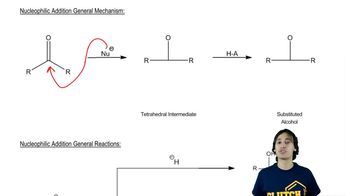
Identify the functional group transformation: The problem involves converting acetophenone (a ketone) into acetophenone cyanohydrin (a cyanohydrin, which contains both a hydroxyl group and a nitrile group attached to the same carbon). This transformation is a nucleophilic addition reaction.
Recall the mechanism of cyanohydrin formation: Cyanohydrins are formed when a ketone reacts with hydrogen cyanide (HCN) in the presence of a catalytic amount of a base, such as NaOH or KCN. The base deprotonates HCN to generate the cyanide ion (CN⁻), which acts as the nucleophile.
Write the reaction conditions: Add HCN to acetophenone in the presence of a catalytic base. The cyanide ion (CN⁻) will attack the carbonyl carbon of acetophenone, forming a tetrahedral intermediate.
Explain the intermediate step: The tetrahedral intermediate will have a negatively charged oxygen atom. This oxygen atom will then be protonated by HCN or another proton source in the reaction mixture, resulting in the formation of the cyanohydrin.
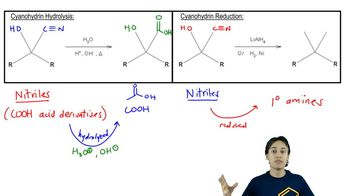
Summarize the product: The final product is acetophenone cyanohydrin, which has a hydroxyl group (-OH) and a nitrile group (-C≡N) attached to the same carbon atom that was originally part of the carbonyl group in acetophenone.
Verified video answer for a similar problem:
This video solution was recommended by our tutors as helpful for the problem above
Video duration:
1m
Play a video:
Was this helpful?
Key Concepts
Here are the essential concepts you must grasp in order to answer the question correctly.
Nucleophilic Addition
Nucleophilic addition is a fundamental reaction in organic chemistry where a nucleophile attacks an electrophilic carbon atom, leading to the formation of a new bond. In the case of synthesizing acetophenone cyanohydrin, the nucleophile (cyanide ion) attacks the carbonyl carbon of acetophenone, resulting in the formation of a cyanohydrin. Understanding this mechanism is crucial for predicting the products of reactions involving carbonyl compounds.
Carbonyl compounds, characterized by the presence of a carbonyl group (C=O), include aldehydes and ketones. Acetophenone is a ketone, and its reactivity is largely due to the electrophilic nature of the carbonyl carbon. Recognizing the properties and reactivity of carbonyl compounds is essential for understanding their transformations, such as the conversion to cyanohydrins.
Cyanohydrin formation involves the addition of hydrogen cyanide (HCN) to a carbonyl compound, resulting in a compound that contains both a hydroxyl group (-OH) and a nitrile group (-CN). This reaction is significant in organic synthesis as cyanohydrins can serve as intermediates for further transformations. Knowing the conditions and mechanisms for cyanohydrin formation is vital for successfully synthesizing acetophenone cyanohydrin.