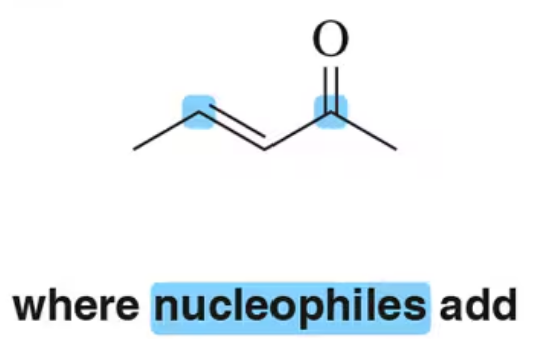
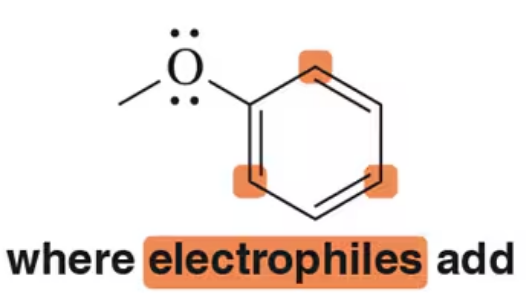
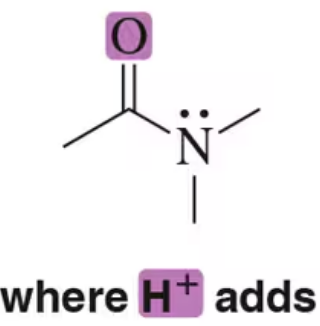
Another way the preceding might be presented is to say that the minor resonance structure(s) reveal the reactivity of a molecule. Show how the minor resonance structure(s) can help us understand that the following reactions occur with the regioselectivity shown. (a) (b) (c)
Verified step by step guidance
1
Identify the major and minor resonance structures of the molecule. Resonance structures are different ways of representing the delocalization of electrons in a molecule. The minor resonance structure typically has a higher energy due to factors like incomplete octets, formal charges, or less favorable electron distribution.
Examine the minor resonance structure to locate regions of electron deficiency (partial positive charges) and electron richness (partial negative charges). These regions indicate where nucleophiles (electron-rich species) and electrophiles (electron-deficient species) are likely to interact with the molecule.
For nucleophilic addition, focus on the regions in the minor resonance structure that exhibit partial positive charges. These are the electrophilic sites where nucleophiles are most likely to attack.
For electrophilic addition, identify regions in the minor resonance structure that exhibit partial negative charges. These are the nucleophilic sites where electrophiles are most likely to add.
To determine where H⁺ (a proton) will add, consider the stability of the resulting intermediate. H⁺ will preferentially add to a site that leads to the most stable carbocation or intermediate, which can often be inferred from the resonance structures.
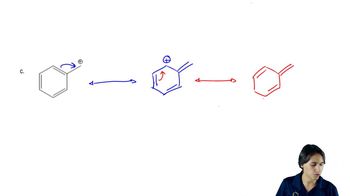
Verified video answer for a similar problem:
This video solution was recommended by our tutors as helpful for the problem above
Video duration:
4m
Play a video:
Was this helpful?
Key Concepts
Here are the essential concepts you must grasp in order to answer the question correctly.
Resonance Structures
Resonance structures are different ways of drawing the same molecule that illustrate the delocalization of electrons. They help in understanding the distribution of electron density across a molecule, which can influence its reactivity. The actual structure of the molecule is a hybrid of these resonance forms, and minor resonance structures can indicate regions of higher or lower electron density, affecting where nucleophiles and electrophiles are likely to react.
Regioselectivity refers to the preference of a chemical reaction to occur at one location over another in a molecule. This concept is crucial in organic reactions, as it determines the major and minor products formed. Understanding regioselectivity often involves analyzing resonance structures, as they can reveal which sites are more favorable for nucleophilic or electrophilic attack based on electron density distribution.
Nucleophiles are species that donate an electron pair to form a chemical bond, while electrophiles are electron-deficient species that accept an electron pair. The interaction between nucleophiles and electrophiles is fundamental in organic reactions. The choice of where these species add to a molecule can be predicted by examining the resonance structures, which highlight the most reactive sites based on electron density.