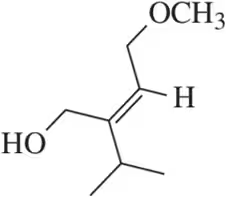
Which of the following alkenes are E and which are Z? (c)
Verified step by step guidance
1
Step 1: Understand the E/Z nomenclature. E/Z isomerism is based on the relative positions of the highest-priority substituents on each carbon of the double bond. The priority is determined using the Cahn-Ingold-Prelog (CIP) rules.
Step 2: Identify the substituents attached to the two carbons of the double bond. In the given structure, one carbon of the double bond is attached to a hydrogen and a hydroxymethyl group (-CH2OH). The other carbon is attached to a methoxy group (-OCH3) and a cyclohexane ring.
Step 3: Assign priorities to the substituents on each carbon using the CIP rules. The substituent with the higher atomic number at the first point of difference gets higher priority. For the first carbon, hydroxymethyl (-CH2OH) has higher priority than hydrogen. For the second carbon, the cyclohexane ring has higher priority than the methoxy group (-OCH3).
Step 4: Determine the relative positions of the higher-priority substituents. If the higher-priority groups are on opposite sides of the double bond, the configuration is E (entgegen, German for 'opposite'). If they are on the same side, the configuration is Z (zusammen, German for 'together').
Step 5: Analyze the structure visually. In the given structure, the hydroxymethyl group and the cyclohexane ring (the higher-priority groups) are on opposite sides of the double bond. Therefore, the configuration of the alkene is E.
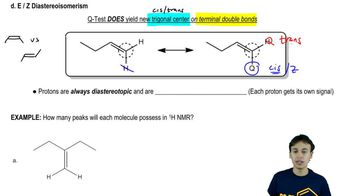
Verified video answer for a similar problem:
This video solution was recommended by our tutors as helpful for the problem above
Video duration:
3m
Play a video:
Was this helpful?
Key Concepts
Here are the essential concepts you must grasp in order to answer the question correctly.
E/Z Isomerism
E/Z isomerism is a type of stereoisomerism that occurs in alkenes due to the restricted rotation around the double bond. The 'E' (entgegen) configuration indicates that the highest priority substituents on each carbon of the double bond are on opposite sides, while the 'Z' (zusammen) configuration indicates they are on the same side. This classification is determined using the Cahn-Ingold-Prelog priority rules.
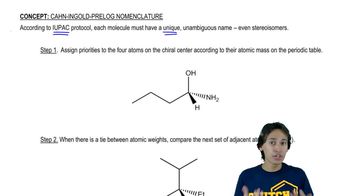
The Cahn-Ingold-Prelog priority rules are a set of guidelines used to assign priority to substituents attached to the double-bonded carbons in alkenes. The priority is based on the atomic number of the atoms directly attached to the double bond; higher atomic numbers receive higher priority. If the first atoms are the same, the comparison continues along the chain until a difference is found.
Alkenes are hydrocarbons that contain at least one carbon-carbon double bond, which introduces a planar geometry around the double bond. This planar structure allows for the possibility of different spatial arrangements of substituents, leading to the formation of E/Z isomers. Understanding the geometry of alkenes is crucial for determining their stereochemical configurations.