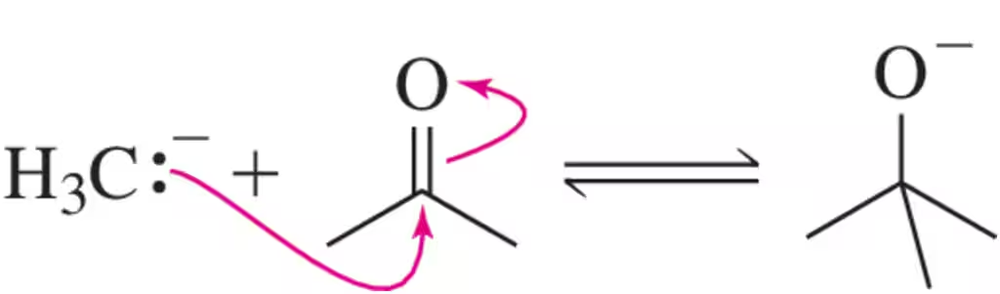
Parts (a)–(d) of this assessment assist in the development of what will become a common theme in organic reactions and should be worked in order. [Think carefully about how each question relates to the others.] (c) Without worrying about the mechanism of the reaction, estimate an equilibrium constant for the following carbonyl addition reaction based on the relative stability of the Lewis bases.
Verified step by step guidance
1
Analyze the reaction: The image shows a nucleophilic addition reaction where a methyl anion (CH₃⁻) attacks the carbonyl carbon of acetone (propanone), resulting in the formation of a tetrahedral intermediate with a negatively charged oxygen atom.
Consider the relative stability of the Lewis bases: The methyl anion (CH₃⁻) is a strong nucleophile but less stable due to its negative charge on a carbon atom. The negatively charged oxygen in the product is more stable because oxygen is more electronegative and better accommodates the negative charge.
Relate stability to equilibrium: The equilibrium constant (K_eq) for the reaction depends on the relative stability of the reactants and products. Since the negatively charged oxygen in the product is more stable than the methyl anion in the reactants, the equilibrium will favor the product side.
Estimate the equilibrium constant qualitatively: A reaction that favors the formation of a more stable product typically has a K_eq greater than 1. Thus, the equilibrium constant for this reaction is expected to be greater than 1, indicating that the product is favored.
Conclude the reasoning: The equilibrium constant estimation is based on the principle that reactions tend to favor the side with more stable species. Here, the stability of the negatively charged oxygen in the product drives the equilibrium toward the product side.
Verified video answer for a similar problem:
This video solution was recommended by our tutors as helpful for the problem above
Play a video:
Was this helpful?
Key Concepts
Here are the essential concepts you must grasp in order to answer the question correctly.
Equilibrium Constant (K)
The equilibrium constant (K) is a numerical value that expresses the ratio of the concentrations of products to reactants at equilibrium for a given reaction. It provides insight into the position of equilibrium, indicating whether products or reactants are favored. A larger K value suggests that products are favored, while a smaller K indicates a preference for reactants.
The relationship between equilibrium constant and pKa.
Lewis Acids and Bases
Lewis acids and bases are defined by their ability to accept or donate electron pairs, respectively. In the context of carbonyl addition reactions, the stability of the Lewis bases involved can significantly influence the reaction's equilibrium. A more stable Lewis base will favor the formation of products, thereby affecting the equilibrium constant.
Carbonyl addition reactions involve the nucleophilic attack of a Lewis base on the electrophilic carbon of a carbonyl group (C=O). This type of reaction is fundamental in organic chemistry, leading to the formation of alcohols or other functional groups. Understanding the stability of the reactants and products is crucial for estimating the equilibrium constant in these reactions.