Give structures of the alkenes that would give the following products upon ozonolysis–reduction. (a)
Verified step by step guidance
1
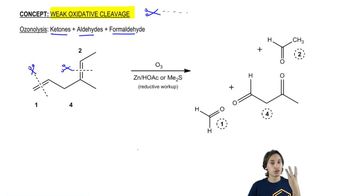
Step 1: Understand the ozonolysis reaction. Ozonolysis is a reaction where an alkene is cleaved by ozone (O₃), resulting in the formation of carbonyl compounds (aldehydes or ketones). The products depend on the position of the double bond in the original alkene.
Step 2: Analyze the given products. The products are two ketones: CH₃COCH₂CH₂CH₂CH₂COCH₂CH₃. This indicates that the original alkene had a double bond that was cleaved to form these two fragments.
Step 3: Determine the structure of the original alkene. To reverse-engineer the process, connect the two carbonyl groups (C=O) from the products to form a double bond. The carbonyl carbons in the products correspond to the carbons that were part of the double bond in the original alkene.
Step 4: Combine the fragments. The original alkene structure would be CH₃CH=CHCH₂CH₂CH₂CH₂CH₃, where the double bond is located between the second and third carbons from the left.
Step 5: Verify the structure. Ensure that the ozonolysis of the proposed alkene structure would yield the given products. Cleaving the double bond in CH₃CH=CHCH₂CH₂CH₂CH₂CH₃ would indeed produce CH₃COCH₂CH₂CH₂CH₂COCH₂CH₃.
Verified video answer for a similar problem:
This video solution was recommended by our tutors as helpful for the problem above
Video duration:
9m
Play a video:
Was this helpful?
Key Concepts
Here are the essential concepts you must grasp in order to answer the question correctly.
Ozonolysis
Ozonolysis is a reaction involving the cleavage of alkenes using ozone (O3) to form carbonyl compounds, such as aldehydes and ketones. The process typically occurs in two steps: first, the alkene reacts with ozone to form a molozonide, which rearranges to form ozonide. The ozonide is then reduced, often using zinc and acetic acid or dimethyl sulfide, yielding the final carbonyl products.
Alkenes are hydrocarbons that contain at least one carbon-carbon double bond (C=C). They are unsaturated compounds and can undergo various reactions, including addition reactions and ozonolysis. The position and substitution of the double bond in alkenes significantly influence the products formed during reactions, making it essential to understand their structure when predicting reaction outcomes.
Reduction reactions involve the gain of electrons or the decrease in oxidation state of a molecule. In the context of ozonolysis, the reduction step converts the ozonide intermediate into carbonyl compounds. Common reducing agents include zinc in acetic acid or dimethyl sulfide, which facilitate the transformation of the ozonide into stable aldehydes or ketones, essential for identifying the original alkene structure.