Practice your electron-pushing skills by drawing a mechanism for the following E1 reactions. (a)
Verified step by step guidance
1
Identify the substrate in the reaction. In an E1 reaction, the substrate is typically a secondary or tertiary alkyl halide or alcohol, which can form a stable carbocation intermediate.
Determine the leaving group. In an E1 reaction, the leaving group departs first, forming a carbocation. Use curved arrows to show the movement of electrons from the bond between the carbon and the leaving group to the leaving group itself.
Analyze the stability of the carbocation formed. If the initial carbocation is not the most stable form, consider possible carbocation rearrangements (e.g., hydride shifts or alkyl shifts) to form a more stable carbocation.
Identify the β-hydrogens on the carbocation. These are hydrogens attached to carbons adjacent to the carbocation. Use curved arrows to show the base abstracting a β-hydrogen, and the electrons from the C-H bond forming a π-bond (double bond) between the α-carbon (carbocation) and the β-carbon.
Draw the final product, which is the alkene formed after the elimination step. If multiple β-hydrogens are available, consider Zaitsev's rule, which predicts that the more substituted alkene is the major product.
Verified video answer for a similar problem:
This video solution was recommended by our tutors as helpful for the problem above
Video duration:
2m
Play a video:
Was this helpful?
Key Concepts
Here are the essential concepts you must grasp in order to answer the question correctly.
E1 Mechanism
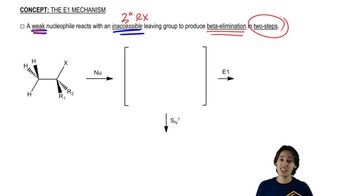
The E1 mechanism, or unimolecular elimination, involves two main steps: the formation of a carbocation intermediate followed by the loss of a leaving group to form a double bond. This process typically occurs in polar protic solvents and is favored by tertiary substrates due to their ability to stabilize the carbocation. Understanding the E1 mechanism is crucial for predicting the products of elimination reactions.
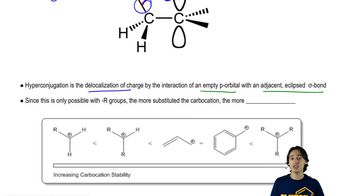
Carbocation stability is a key factor in E1 reactions, as the rate-determining step involves the formation of a carbocation. Tertiary carbocations are more stable than secondary or primary ones due to hyperconjugation and inductive effects from surrounding alkyl groups. Recognizing the stability of different carbocations helps in predicting the pathway and products of elimination reactions.
Electron-pushing curved arrows are a fundamental notation in organic chemistry used to illustrate the movement of electrons during chemical reactions. In the context of E1 reactions, these arrows show how electrons are transferred from nucleophiles to electrophiles, and how bonds are formed or broken. Mastery of this notation is essential for accurately depicting reaction mechanisms and understanding the flow of electrons.