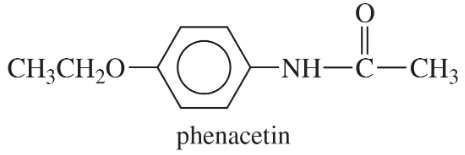
The following drugs are synthesized using the methods in this chapter and in previous chapters. Devise a synthesis for each, starting with any compounds containing no more than six carbon atoms. (a) Phenacetin, used with aspirin and caffeine in pain-relief medications.
Verified step by step guidance
1
Step 1: Analyze the structure of phenacetin. It consists of a benzene ring with two substituents: an ethoxy group (-OCH2CH3) and an acetamide group (-NHCOCH3). The synthesis will involve constructing the benzene ring and adding these substituents step by step.
Step 2: Start with a simple benzene derivative, such as phenol (C6H5OH), which contains no more than six carbon atoms. Phenol can serve as the precursor for introducing the ethoxy group via an etherification reaction.
Step 3: Perform an etherification reaction on phenol. React phenol with ethyl bromide (CH3CH2Br) in the presence of a base, such as sodium hydroxide (NaOH), to form ethoxybenzene (C6H5OCH2CH3). This introduces the ethoxy group onto the benzene ring.
Step 4: Introduce the acetamide group. React ethoxybenzene with acetic anhydride ((CH3CO)2O) in the presence of a catalyst, such as pyridine, to form phenacetin. This step involves acetylation of the amine group to form the acetamide functionality.
Step 5: Verify the synthesis pathway. Ensure that the final product matches the structure of phenacetin, with the ethoxy group and acetamide group correctly positioned on the benzene ring.
Verified video answer for a similar problem:
This video solution was recommended by our tutors as helpful for the problem above
Video duration:
2m
Play a video:
Was this helpful?
Key Concepts
Here are the essential concepts you must grasp in order to answer the question correctly.
Organic Synthesis
Organic synthesis is the process of constructing organic compounds through chemical reactions. It involves a series of steps that transform starting materials into desired products, often requiring knowledge of reaction mechanisms, functional group transformations, and the use of reagents. Understanding the principles of organic synthesis is crucial for devising pathways to synthesize complex molecules like drugs.
Synthesis of Amino Acids: Strecker Synthesis Example 1
Functional Groups
Functional groups are specific groups of atoms within molecules that are responsible for the characteristic chemical reactions of those molecules. In organic chemistry, recognizing functional groups is essential for predicting reactivity and determining the appropriate synthetic routes. For example, phenacetin contains an ether and an amide functional group, which influence its synthesis and properties.
Retrosynthetic analysis is a strategy used in organic chemistry to break down complex molecules into simpler precursor structures. This approach involves working backward from the target molecule to identify potential starting materials and synthetic pathways. It is a critical skill for chemists when planning the synthesis of compounds like phenacetin, as it helps in visualizing the steps needed to construct the desired product.