In Chapter 13, we learned that epoxide opening can give different products, depending on whether the reaction occurs under acidic or basic conditions. Explain why the epoxide shown opens identically under either set of conditions.
Verified step by step guidance
1
Step 1: Analyze the structure of the epoxide. The epoxide is a three-membered cyclic ether, which is highly strained and reactive. In this case, the epoxide is attached to a benzene ring and a tertiary carbon, making it asymmetric.
Step 2: Understand the mechanism of epoxide opening under basic conditions. Under basic conditions, the nucleophile (e.g., NaOEt) attacks the less substituted carbon of the epoxide due to steric hindrance. This results in the opening of the ring and formation of a product where the nucleophile is attached to the less substituted carbon.
Step 3: Understand the mechanism of epoxide opening under acidic conditions. Under acidic conditions, the epoxide is protonated first, making it more electrophilic. The nucleophile (e.g., EtOH) then attacks the more substituted carbon of the epoxide due to the stability of the carbocation intermediate formed during the reaction.
Step 4: Explain why the epoxide opens identically under both conditions. In this case, the epoxide is attached to a tertiary carbon and a benzene ring. The benzene ring stabilizes the transition state through resonance, and the tertiary carbon is sterically hindered. These factors make the nucleophile attack the same carbon (the benzylic carbon) under both acidic and basic conditions.
Step 5: Conclude that the identical product formation is due to the unique structure of the epoxide. The benzylic position is both electronically favored (due to resonance stabilization) and sterically accessible compared to the tertiary carbon, leading to the same product regardless of the reaction conditions.
Verified video answer for a similar problem:
This video solution was recommended by our tutors as helpful for the problem above
Play a video:
Was this helpful?
Key Concepts
Here are the essential concepts you must grasp in order to answer the question correctly.
Epoxide Structure and Reactivity
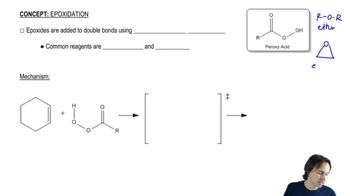
Epoxides are three-membered cyclic ethers that are highly strained due to their angular strain. This strain makes them reactive, allowing them to undergo ring-opening reactions. The reactivity of epoxides is influenced by the nature of the substituents and the conditions under which the reaction occurs, such as acidic or basic environments.
In acidic conditions, the epoxide oxygen can be protonated, increasing the electrophilicity of the carbon atoms in the epoxide ring. This makes it easier for nucleophiles to attack. In basic conditions, nucleophiles can directly attack the less hindered carbon atom of the epoxide. Despite the different mechanisms, both conditions can lead to similar products due to the nature of the nucleophilic attack.
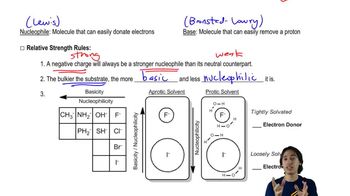
Understanding the difference between basicity and nucleophilicity.
Nucleophilic Attack and Product Formation
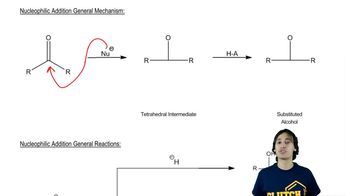
The nucleophilic attack on the epoxide can occur at either carbon atom, leading to the opening of the ring. The resulting product depends on the sterics and electronics of the nucleophile and the epoxide. In this case, both acidic and basic conditions yield similar products because the nucleophile can effectively attack the same site, resulting in the same final structure despite the different pathways.