
An unknown compound has the molecular formula C9H11Br. Its proton NMR spectrum shows the following absorptions: singlet, δ7.1, integral 44 mm singlet, δ2.3, integral 130 mm singlet, δ2.2, integral 67 mm Propose a structure for this compound.
Verified step by step guidance
1
Step 1: Analyze the molecular formula C9H11Br. This indicates the compound contains 9 carbon atoms, 11 hydrogen atoms, and 1 bromine atom. The presence of bromine suggests the compound may be an alkyl bromide or an aromatic bromine derivative.
Step 2: Examine the proton NMR data. The spectrum shows three singlets, which suggests that the hydrogens are in distinct environments and do not couple with neighboring hydrogens. This is indicative of isolated groups or symmetrical environments.
Step 3: Interpret the chemical shifts (δ values). The singlet at δ7.1 is characteristic of aromatic hydrogens, suggesting the presence of a benzene ring. The singlets at δ2.3 and δ2.2 are in the aliphatic region, indicating hydrogens attached to sp3 carbons.
Step 4: Consider the integrals. The integral values correspond to the relative number of hydrogens in each environment. The singlet at δ7.1 (44 mm) corresponds to 4 hydrogens, which is unusual for a benzene ring unless it is substituted. The singlet at δ2.3 (130 mm) corresponds to 6 hydrogens, likely from two equivalent methyl groups. The singlet at δ2.2 (67 mm) corresponds to 1 hydrogen, possibly from a methine group.
Step 5: Propose a structure. Based on the data, the compound likely contains a benzene ring substituted with a bromine atom and an isopropyl group (C(CH3)2H). The benzene ring accounts for the aromatic hydrogens, the isopropyl group accounts for the aliphatic hydrogens, and the bromine atom completes the molecular formula.
Verified video answer for a similar problem:
This video solution was recommended by our tutors as helpful for the problem above
Video duration:
3m
Play a video:
Was this helpful?
Key Concepts
Here are the essential concepts you must grasp in order to answer the question correctly.
Molecular Formula Interpretation
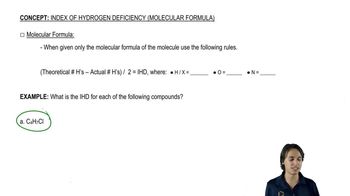
The molecular formula C9H11Br indicates the compound contains 9 carbon atoms, 11 hydrogen atoms, and 1 bromine atom. Understanding the molecular formula is crucial for deducing the possible structure of the compound, as it provides insight into the degree of saturation and the presence of functional groups. The ratio of hydrogen to carbon suggests the compound may contain rings or multiple bonds.
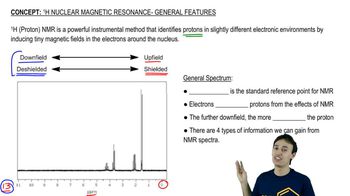
Proton NMR (Nuclear Magnetic Resonance) spectroscopy is a technique used to determine the structure of organic compounds by analyzing the environment of hydrogen atoms in the molecule. The chemical shifts (δ) indicate the electronic environment of the protons, while the integrals provide information about the number of protons contributing to each signal. In this case, the three singlets at different δ values suggest distinct environments for the hydrogen atoms.
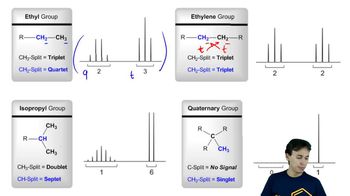
In NMR spectroscopy, integration refers to the area under the peaks, which correlates to the number of protons contributing to that signal. The singlet nature of the peaks indicates that the protons are not coupled to neighboring protons, suggesting they are in isolated environments. Analyzing the integrals (44 mm, 130 mm, and 67 mm) helps in determining the relative number of protons in each environment, which is essential for constructing the molecular structure.