Which of the following compounds decarboxylates when heated?
Verified step by step guidance
1
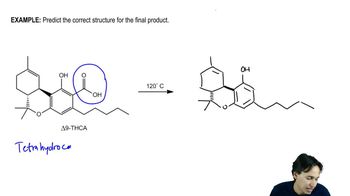
Step 1: Understand the concept of decarboxylation. Decarboxylation is the removal of a carboxyl group (-COOH) from a molecule, typically releasing carbon dioxide (CO₂). This reaction often occurs in compounds with a β-keto acid or a carboxylic acid group adjacent to a carbonyl group.
Step 2: Analyze compound (i). This compound contains two carboxylic acid groups (-COOH) attached to a cyclohexane ring. However, neither of these carboxylic acid groups is adjacent to a carbonyl group, which is necessary for decarboxylation to occur under heating.
Step 3: Analyze compound (ii). This compound has a carboxylic acid group (-COOH) adjacent to a ketone group (C=O). This structure is characteristic of a β-keto acid, which readily undergoes decarboxylation when heated.
Step 4: Analyze compound (iii). This compound contains a hydroxyl group (-OH) and a carboxylic acid group (-COOH) attached to a cyclohexane ring. However, the carboxylic acid group is not adjacent to a carbonyl group, so it does not decarboxylate under heating.
Step 5: Analyze compound (iv). This compound contains two ketone groups (C=O) attached to a cyclohexane ring but lacks a carboxylic acid group (-COOH). Decarboxylation requires the presence of a carboxylic acid group, so this compound does not undergo decarboxylation.
Verified video answer for a similar problem:
This video solution was recommended by our tutors as helpful for the problem above
Video duration:
2m
Play a video:
Was this helpful?
Key Concepts
Here are the essential concepts you must grasp in order to answer the question correctly.
Decarboxylation
Decarboxylation is a chemical reaction that involves the removal of a carboxyl group (-COOH) from a molecule, resulting in the release of carbon dioxide (CO2). This process is often facilitated by heat and is common in organic compounds containing carboxylic acids. Understanding the conditions under which decarboxylation occurs is crucial for predicting the behavior of organic compounds when heated.
Carboxylic acids are organic compounds characterized by the presence of one or more carboxyl groups (-COOH). They are known for their acidic properties and can undergo various reactions, including decarboxylation. Identifying the presence of carboxylic acid functional groups in the given compounds is essential for determining which compounds are likely to decarboxylate upon heating.
The thermal stability of functional groups refers to their ability to withstand heat without undergoing decomposition or reaction. Different functional groups have varying stabilities; for instance, carboxylic acids can decarboxylate when heated, while other groups may not. Analyzing the structures of the compounds in the question helps assess their thermal stability and predict their behavior under heat.